



Home Bodies had its world premiere at the 2026 Fantasia International Film Festival on July 23.
It has been 14 years since Casey Walker last brought a film to Fantasia. His horror-comedy A Little Bit Zombie played the Montreal festival in 2012, and he has remained connected to Canadian genre filmmaking since then, including as a producer on The Void and In a Violent Nature.
Walker returns as the director and producer of Home Bodies, working alongside producer Karen Harnisch and executive producers Todd Brown and Chad Archibald. VVS Films holds the Canadian distribution rights.
Fantasia is a fitting place for Walker’s return, although Home Bodies requires some patience. The first third does not entirely convince, with ideas that initially feel too broad and obvious for its strange little world. Once the film pushes against its own routine, however, it develops into an engaging and surprisingly fun retro science-fiction story.
What Is Home Bodies About?
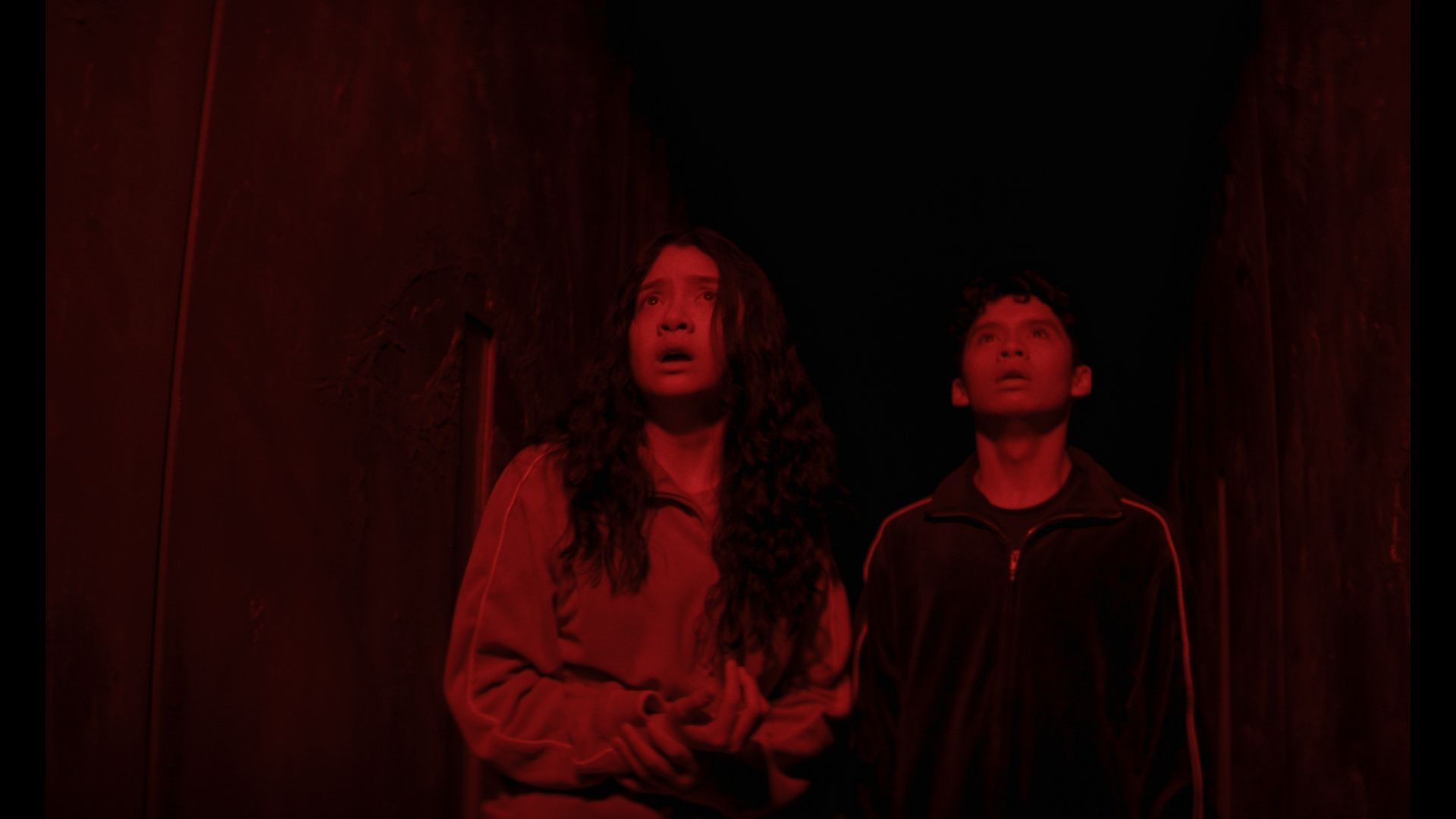
Red (Emma Ho) and Blue (Ian Ho) are twins who have spent their lives inside an automated home. They wear colour-coded clothing, eat the food provided to them, and watch old VHS tapes of a children’s program called “Barn.”
Their lives are governed by Papa, a disembodied voice speaking from behind a locked door. Papa provides food, shelter, and order, but his rules also define the limits of their world. Red and Blue have no meaningful privacy, no access to outside information, and little reason to imagine that another kind of life exists.
The routine changes during a Christmas-like holiday when they receive Pal (Ess Hödlmoser), a silent, androgynous humanoid. Pal also receives VHS tapes, though their content is much more disturbing than “Barn.” As Red becomes fascinated with their new companion, Blue tries to preserve the life the twins already have.
The names Red and Blue create a dichotomy that is difficult to miss, especially after years of “red pill” and “blue pill” discourse. At first, the symbolism feels a little too neat. Blue accepts the familiar system and fears disruption, while Red is more willing to test its limits in pursuit of something resembling the truth.
The film eventually finds more interesting places to take that divide. Red’s curiosity is not automatically liberating, and Blue’s fear is not merely cowardice. Both have been shaped by the same environment, without the freedom or information to build identities beyond what Papa permits.
Life Inside the Fishbowl
The cinematography makes that absence of freedom visible. Home Bodies relies heavily on wide-angle lenses, creating the sense that Red and Blue are living in a fishbowl. The distorted perspective makes the house feel both exposed and uneasy.
The camera sometimes watches from inside the refrigerator, garbage can, and other household objects. These placements extend the film’s sense of surveillance into the home itself, making even ordinary routines feel observed. They also reminded me of a familiar YouTube-vlogging technique, where cameras are placed inside cupboards, refrigerators, and other objects to capture a supposedly unusual point of view. What once felt inventive has become another widely copied visual convention, although that derivative quality fits a film about identities shaped by narrow and repetitive media.
Red and Blue watch the same characters, eat the same food, wear the same clothes, and repeat the same behaviours every day. It recalls an online culture in which people imitate the same personalities, formats, and gestures until individual expression looks mass-produced.
That repetition, while a part of the film’s design, does occasionally drag its pacing. Understanding why a sequence repeats does not always make it dramatically satisfying. Despite that, Walker manages to create a low, persistent dread that carries us through the runtime.
A Future Designed to Look Like the Past

The production design is one of the film’s strongest elements. The home combines automation with retro furniture, an old-fashioned kitchen, and VHS technology. It imagines the future through objects that already look outdated.
That contradiction suits a story in which technological progress has not produced greater freedom. Every convenience makes the twins more dependent on a system they cannot question. Its technology points forward while its social order moves backward.
Red and Blue have surrendered autonomy without knowing they possessed it. Their lives have been reduced to consumption, routine, and obedience. The house can enforce Papa’s authority without his physical presence.
Emma Ho and Ian Ho do a solid job carrying most of the film. Their performances can be exaggerated, particularly in the opening sections, and there are moments when the delivery does not completely land.
It is also difficult to know what “natural” acting should look like in this situation.
Red and Blue have grown up without ordinary social contact. Their behaviour has been shaped by Papa, “Barn,” and each other. If they spoke and reacted like ordinary teenagers, that might be less convincing than their heightened, slightly artificial performances.
Hödlmoser gives the film its most unsettling performance. Pal’s silence and expressionless physicality allow the twins to project different meanings onto the same figure. They can be a gift, friend, threat, or possible route to freedom, sometimes within the same scene.
Is Home Bodies Worth a Watch?
Home Bodies is worth watching for anyone willing to give its slow opening room to develop. Its commentary on automation, identity, and social control is not especially subtle, and the film never fully escapes the familiarity of its influences. The red-and-blue symbolism is particularly blunt.
Still, Walker maintains enough underlying dread to keep the routine from becoming inert, and the film becomes more playful and engaging as Pal fractures the twins’ prescribed existence. The ending may divide audiences, but it takes the premise somewhere more interesting than the opening suggests.
The result is a solid, peculiar slow burn with strong production design, an unnerving central presence, and enough visual curiosity to reward patience.


