

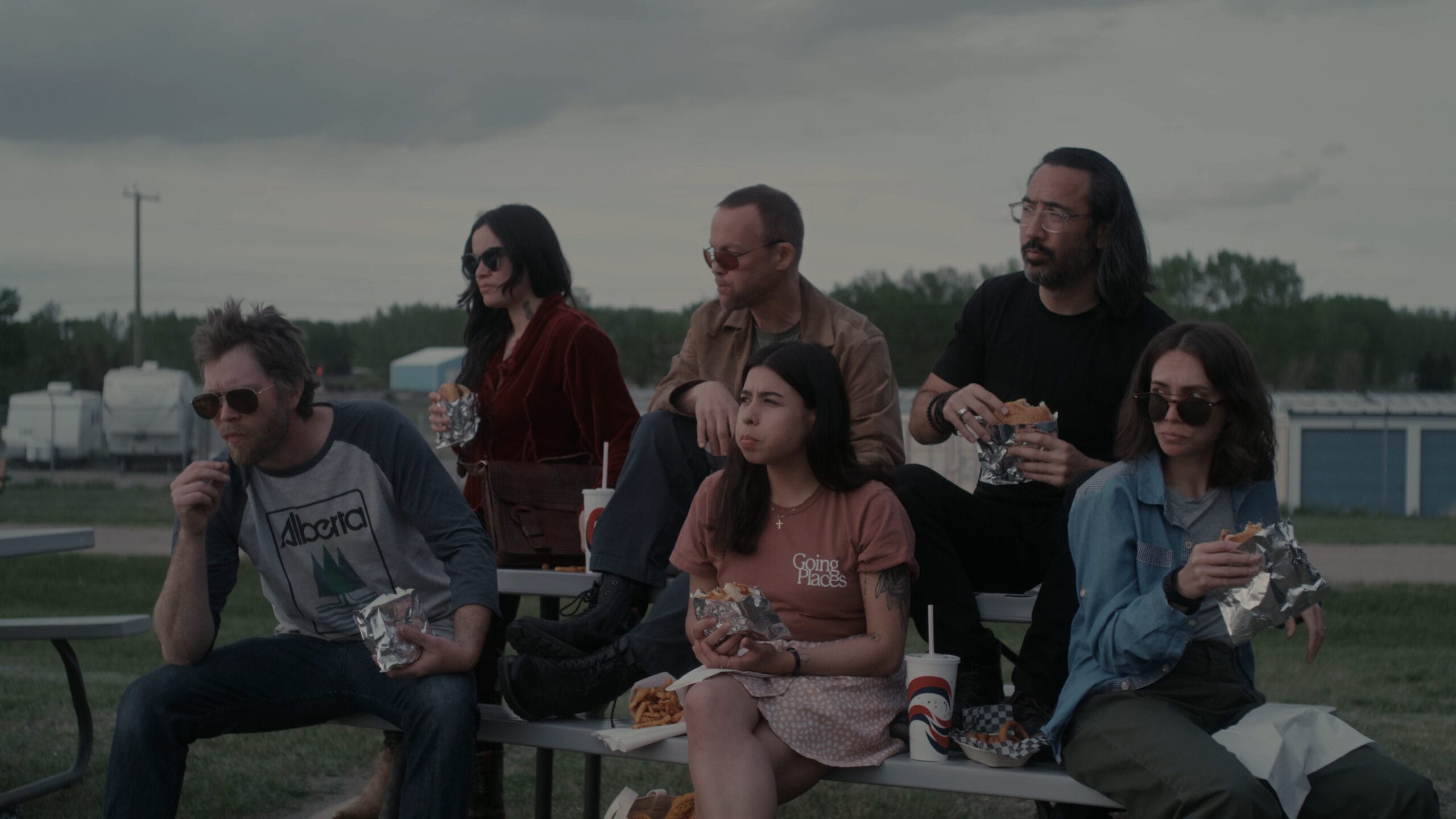

Alberta Number One: Alexander Carson on Crafting a Unique Meta-Textual Alberta Landscape
I had the chance to sit down with Alexander (Sandy) Carson to talk about Alberta Number One, and it quickly became clear that he is most comfortable marching to the beat of his own drum. His passion for art and film is obvious, but so is his lack of interest in making something the way you are taught in film school; instead, he is willing to push against traditional beats and shape a film that feels wholly its own. The result is an Alberta-shot feature from Calgary-based North Country Cinema that folds road movie, essay film, and ensemble drama into a meta-textual portrait of the province. Already on a mini-Canadian theatrical tour, the film is currently rolling through Ottawa, Toronto, Vancouver, Calgary, and Edmonton.
Alberta Number One and Its Ineffable DNA
Some films are easy to pin down; Alberta Number One is not one of them. It folds fiction, documentary, autoethnography, and a film-within-a-film structure into a relatively compact runtime, making any neat, one-line description feel reductive at best. It has already been mislabelled in a few places as a “mockumentary,” which ultimately misses the point of what the film is doing both formally and politically. Rather than trying to force it into a tidy box myself, I asked Alexander to talk through what the film is to him, and how he understands its complicated DNA.
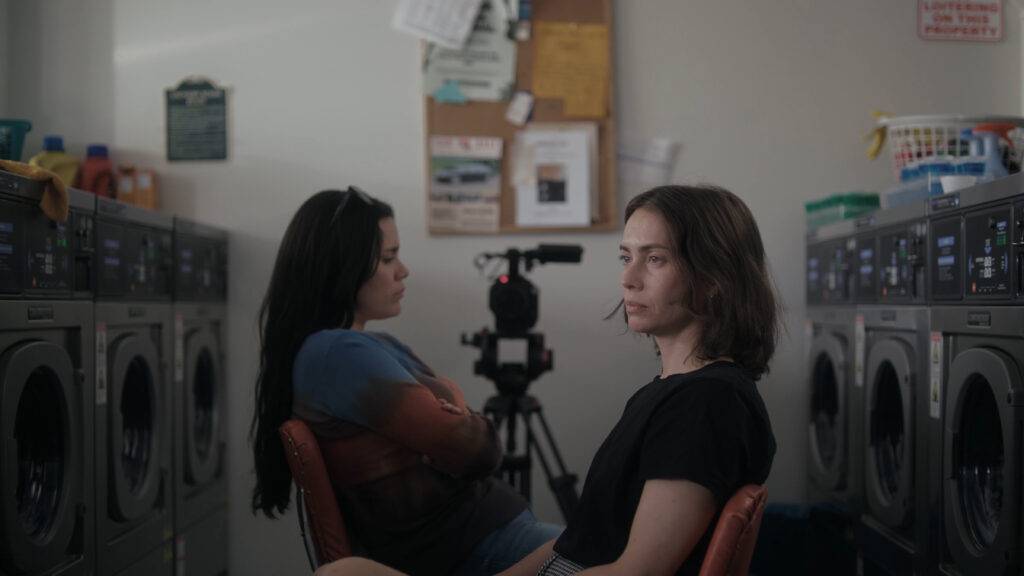
Alberta Number One Still (Laundromat) | Photo Credit: David Ehrenreich
Adam Manery:
I know this is a hard one to boil down, but what is Alberta Number One about? What’s your elevator pitch for the film?
Alexander (Sandy) Carson: I’m not too good at elevator pitches, so bear with me. It’s a fiction film about a documentary process. There is a bit of hybridity, because sometimes we dip into “the film within the film”, like when filming at the Museum of Miniatures or the Creation Science Museum, but it’s mostly a behind-the-scenes look at a documentary process. It’s not so much a film about the museums and public sites themselves as it is an autoethnographic work, meaning that they’re including themselves in the study of the experience of museums and public sites.
Some of the interesting tension in the film, for me at least, comes from the relationship between the professor and the crew having a certain way of approaching the material that feels “particular”. They don’t actually hold themselves to the standards that they’re purporting to live up to, because they’re all keeping secrets from each other and manipulating each other with power dynamics and things to do with privilege and race and gender.
I felt like I had reached a bit of a limit with where I could take my own investigation of the subject matter. I thought we needed to get some more voices in the mix. – Director Alexander Carson on the collaborative nature of Alberta Number One
That’s the interesting tension: looking at the public narratives that are being told through these sites and the private narratives that are occurring within the space, even within the group’s dynamic. Then, how does the interplay between those two layers, or ways of reading the film, combust or create an energetic tension?
I don’t think I answered your question, but that’s some of what is going on that makes the film interesting.
That feels like the nature of the film: it really resists being summed up in a single sentence. Depending on the lens you bring to it, it can offer something different to each viewer.
That’s one of its gifts. Everyone who watches this film will have a different experience based on their own perspective, their own lived experience, their own politics.
There is no singular or preferred reading for the film. I like people to be able to intersect with it from all these different points of view, find different ways into the work, and find different things interesting or banal or amusing. There are so many ways you can approach the material.
The Collaborative Nature of Alberta Number One
One of the most interesting things about Alberta Number One is the way it was built from the ground up with other artists. Rather than writing characters in isolation and then casting actors to fill the roles, Alexander invited a group of collaborators into the process early, asking them to research, write, and reflect, and then had most of them step in front of the camera as versions of the characters they helped create. They aren’t playing themselves, but rather, they are inhabiting roles that emerged from their own lived experiences and creative practices. That approach brings a rare mix of perspectives, textures, and energies into the film, adding yet another layer to this ineffable tapestry of style, voice, and point of view.
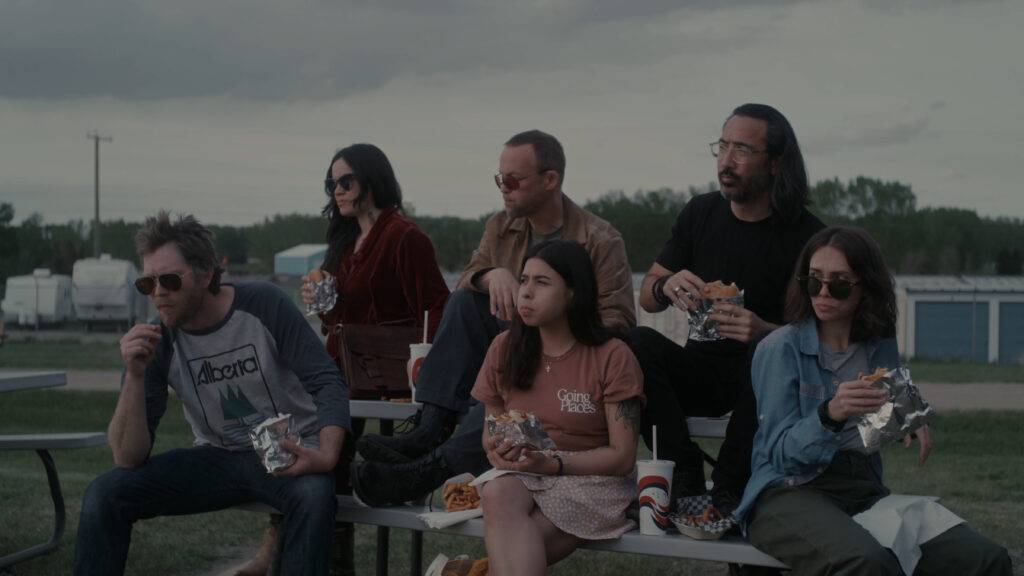
Alberta Number One Still (The Ensemble) | Photo Credit: David Ehrenreich
That makes sense, given how many people contributed to the story. It’s such an obviously collaborative project, with other artists bringing ideas and many of them ending up in front of the camera as well. How did this come together? What’s the origin story of the project?
I did a first round of research on my own, road tripping around Alberta, driving and staying in motels, visiting these museums, writing notes, and talking to the curators or the owners, because some of them are just mom-and-pop shops where the curator and the owner are the same person.
I was talking to people firsthand and talking to professors associated with some of the bigger institutions. Then I felt like I had reached a bit of a limit with where I could take my own investigation of the subject matter. I thought we needed to get some more voices in the mix.
We need to get some more folks from Alberta. We need some diversity of perspective in terms of Indigenous voices, other POC voices, people from different disciplinary backgrounds, because for me, just approaching it with a “capital-F film” focus was also a way in which the process was being limited. So I thought, let’s get some musicians, let’s get some people from theatre. I invited my brother to be part of the process just because I’ve made so many films with him over the years, and he doesn’t even identify as an artist. He calls himself a carpenter and specifically not an artist.
I was really drawn to the people. I was drawn to the landscape. I was drawn to, let’s call it what it is, the weirdness of the media. There is almost a “culture” to it… I think of Alberta as a place of contradictions. – Director Alexander Carson on making an “Alberta” film
I gave them contracts to do a series of writing correspondences where I would give them a field research activity to do: to reflect on a museum visit of their own, or to reflect on a personal collection that they have. These were pretty structured activities in terms of the ways they were presented to the collaborators, but what they fed back to me was totally different.
Some people included photos, some people made videos, and there was a written component to it. I kept an eye on all of that material and kept it close by whenever I was writing, and that fed into the screenplay as it evolved over the years.
The Unique Tapestry of Alberta: A Place of Contradictions
I was born and raised in Alberta, and even though I’ve spent stretches of my life in Ontario and the United Kingdom, this province is still home for me, complicated feelings and all. I actually just wrapped production on an educational documentary series about Alberta’s history through the lens of innovation, and it was funny to realize that, despite being a very different project, we shared some of the same locations as Alberta Number One, including the Reynolds Museum. Alexander has his own long, layered history with the province, having made so much work here over the years, and carries a similarly conflicted affection for it. I was curious, then, about “why Alberta” for this film in particular: what is it about this place, with all its contradictions, that keeps drawing him back?
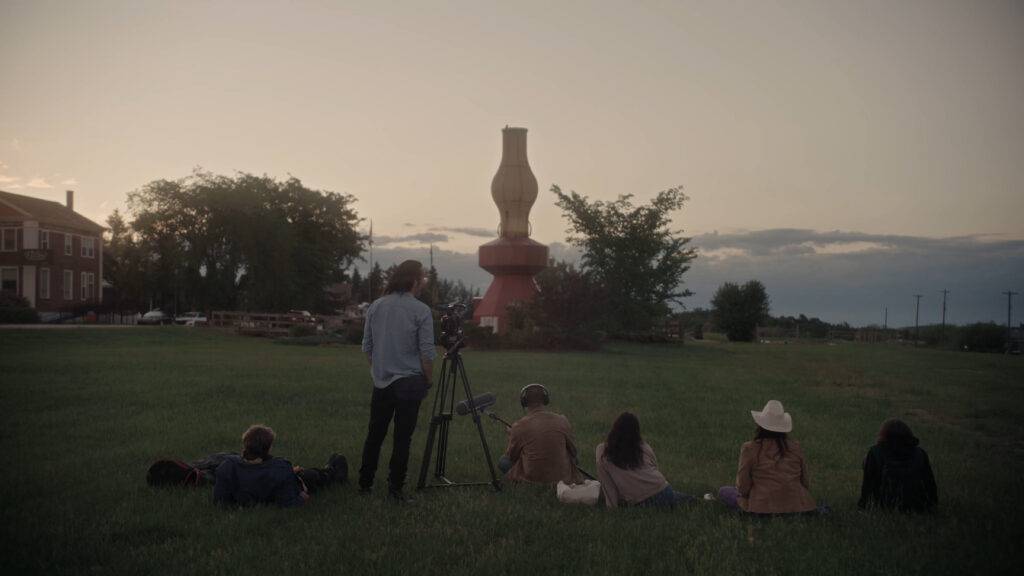
Alberta Number One Still (Donalda) | Photo Credit: David Ehrenreich
You mentioned that you’re from Ontario and that you’ve also spent a chunk of time living in Alberta. What was it about Alberta specifically that made you want it to be the focal point for this film?
I’ve had a company in Calgary for 20 years, which is North Country Cinema. We’ve made most of our work there over the years. We have a great relationship with the local crew and creative folks that we like to keep coming back to.
For example, Kris Demeanor has been in a bunch of Kyle’s movies, going back to the short-film-making days, and I’d always wanted to do something with Kris. I wanted to do something with Randall Okita, whom I know from Toronto, but I originally knew him as an Alberta-based filmmaker.
I was really drawn to the people. I was drawn to the landscape. I was drawn to, let’s call it what it is, the weirdness of the media. There is almost a “culture” to it, where each small town has a niche or a single-topic museum. Other places have monuments, roadside attractions, and small museums, but the interesting tapestry of what Alberta has to offer kept me coming back.
…they bring a real generosity of spirit and a fresh energy that’s not so typical of the very polished or virtuosic types of performances you see in a lot of film and television. – Director Alexander Carson on the ensemble cast in Alberta Number One
I think of Alberta as a place of contradictions. You can be having a great conversation with somebody, really hitting it off, and then you find out that their political views are not aligned with your own. You might find out that this person you’ve just been talking to for the past two hours is a very far-right-wing conservative, and that does not align with my experience of the conversation we just had. I feel like that type of dissonance is baked into the DNA of the province in a way that I find challenging, but it also keeps me coming back.
It keeps my curiosity. It keeps me wanting to scratch at that and to better understand it and to check my own positions and expressions, to take more accountability for what I’m bringing to the conversation or to the experience. I think of Alberta as this place of beautiful contradiction that keeps my curiosity and keeps me wanting to return.
I agree, and that connects to something else I was curious about. I think a lot of people who watch the film are going to be especially struck by one museum in particular: the Big Valley Creation Museum. What was your approach to shooting there? It feels like it could easily tip into something much more pointed, but instead, you largely just let him speak.
You can’t do much to constrain Harry Nibourg. I’ve been a few times over the years, and it’s usually a version of what you see on screen. He has never previously gone off on a tangent about aliens, so that was all new and totally unexpected. There is a different part of his presentation where he goes on about dragons, but that part tracks a bit more.
I sent the crew in and said, “Good luck, guys.” We had chatted with Harry before, and we told him the kind of film that we’re making. For folks who are not in film, they hear it’s a “film about a film”, and that’s not necessarily interesting for a lot of people. They’re just like… “You’re making a film, and you want to shoot at my museum. When are you coming? Let’s book it in.”
We tried to be ethically transparent and not editorialize too much. We don’t want to tee it up for the viewers. We want people to make up their own minds. We didn’t want to seem condescending.
Harry’s like, “I know you guys are from the city… I’m onto you. Do whatever you’re going to do.” He let us know that he was wise to what tricks we might have up our sleeve, but I told him there were no tricks. We were going to let him do most of the talking. We were just going to ask some questions; we’re going to let people make up their minds for themselves. He even says the same thing in the film: “I’m not telling you what to think or what to believe in, I’m just saying to look into it.”
Even though the part about the aliens and the fallen angels and the demons gets a little bit wacky, a lot of what he says is actually pretty beautiful about love and how you treat your common man. I think that we gave him a good shake at it, and that’s what we want people to take away from these experiences. We’re not saying this is a good museum or that it has problems. You can decide.
There was an interesting conversation I had with a professor early on in the research process. She said, “What other places are you going to?” I told her, these more off-the-beaten-track places, not always recognized museums, in the case of some of these mom-and-pop shops, but that’s Alberta. You have the big established places like the Reynolds Museum and the University of Calgary, and then you have the ones that will call themselves museums, whether you like it or not. They’re going to tell their own stories and show what they want to show, and that’s the freedom of expression I value so deeply. Not everyone is going to necessarily appreciate every place that’s featured within the film, but that’s a subjective call.
Grounding Alberta Number One within an Array of Visual and Filmmaking Techniques
Formally, Alberta Number One feels like it’s drawing from an almost inexhaustible toolbox: Brechtian staging and cinema verité with surreal flourishes, documentary observation, and even beats of a buddy road movie thrown in. That mix extends beyond the visuals into structure, tone, and editing, so the film constantly shifts registers without ever settling into one fixed mode. Given the sheer volume of elements in play from top to bottom, I was curious what Alexander kept returning to as the core that grounded everything, and how that translated into his collaboration with cinematographer David Ehrenreich.
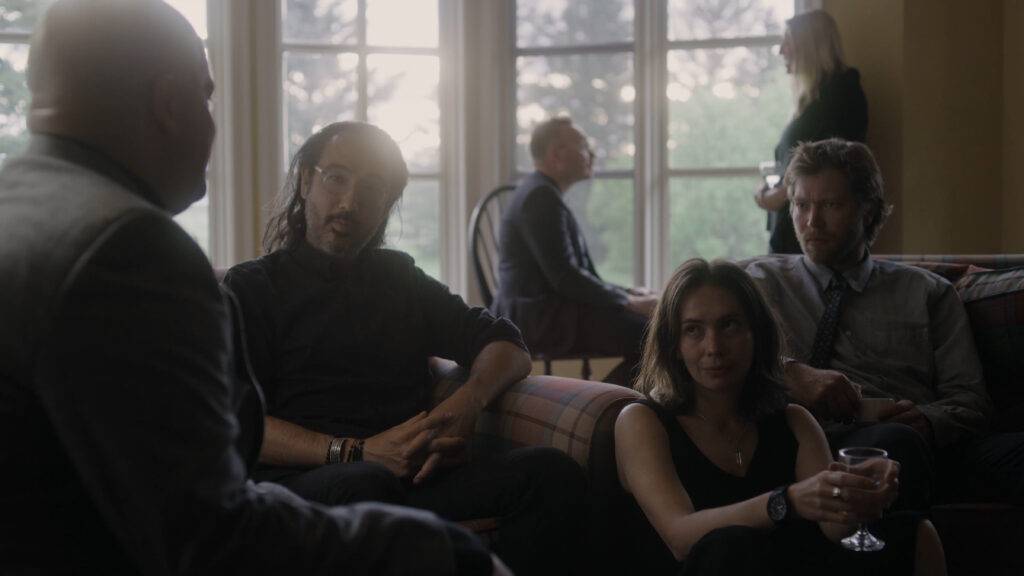
Alberta Number One Still (Funeral) | Photo Credit: David Ehrenreich
You’ve woven so many different styles of filmmaking and so many elements into this movie. What, for you, was grounding it all? What was the one thing you kept coming back to as you were making the film?
The ensemble and the characters themselves. The people who performed in the film poured so much life into the characters. Even though most of them are not “professional” actors, they bring a real generosity of spirit and a fresh energy that’s not so typical of the very polished or virtuosic types of performances you see in a lot of film and television.
Not to say that the acting is not good; I love the acting. It has a bit of rawness to it that comes from working with people with different levels of experience and styles of performance. I knew that I could come back to the people, and that if I was having a hard time and couldn’t figure something out, I had all these amazing artists who are great problem solvers in their own areas of creative practice. I knew I’d be able to keep coming back to these guys and say, “How are we going to fix this scene, or how are we going to find our way out of this dilemma that we’re facing?” That was my rock.
And speaking of talented collaborators, this film is gorgeous. You worked with David as your DP, and it’s beautifully shot, especially those drab hotel rooms where the framing and composition are so striking. What was it like collaborating with David? What kind of director are you when it comes to working with your cinematographer?
David Ehrenreich, who’s a DP from Vancouver, mostly identifies as a director, which was part of the reason I was so drawn to working with him. He can think like an editor, like a director, like a producer, and, obviously, he can think quite brilliantly as a DP.
To everyone’s chagrin, we would roll up on the day and go in and say, “You want to put the camera over here? Yeah, let’s do that.” It was a bit make-it-up-as-you-go. We did lots of scouting and talked about ideas, but then you show up on the day, and something’s different, or somebody is wearing something different that gives you a different idea about how you might want to cover the scene. You never know.
I’m not a storyboarder. I’m not a planner necessarily. I like to be flexible. I think other people were a bit frustrated with our process, but I like to be in the moment. We kept the conversation going and kept trying to approach each space with fresh eyes and say, “Okay, we were here three weeks ago doing a scout, and we talked about doing it this way, but now the light is different. Are we sure we don’t want to put the camera outside?”
It was very collaborative. It was honestly one of the most rewarding experiences of my life.
It draws attention to itself as a layer of text complementing what’s happening with the characters or the museums or whatever other cinematic registers we’re playing on. – Director Alexander Carson on the score of Alberta Number One and working with Brodie West
I was also the assistant director. We had an assistant director in pre-production who had to leave the project, and I said, “Let’s not replace her because I don’t want to follow a super-tight schedule. I want to be able to be fast and loose and a little bit messy.” With that comes other problems, but I think the advantages outweigh them. You see what the film ended up looking like, and it does feel quite deliberate, even though there is such a huge variety of styles. There’s handheld, there are very pronounced, dramatic angles, and there are other moments that are more minimalist. To some extent, that mirrored the narrative trajectory of the film, which is a bit disjointed and does not follow a linear path.
Then there’s the music being kind of jazzy. I felt like we were jazzy ourselves with our visual style, our melange of influences. What you get is a bit of a mess, but an intentional one.
Working with Brodie West and Crafting a Unique Score
Another element that really stands out is the score, which feels almost as singular as the film itself. It has a slightly off-kilter presence that sometimes cuts against the grain of the images and structure while still deepening and amplifying what’s happening on screen. But, at the same time, it adds weight to certain edits and seems to give “more” to moments that might otherwise play differently in a more conventional register. Even if my technical musical vocabulary is limited, I kept feeling myself pulled toward what the score was doing, so I wanted to dig into how it came together and what it was like for Alexander to build this sound world in collaboration with Brodie West.
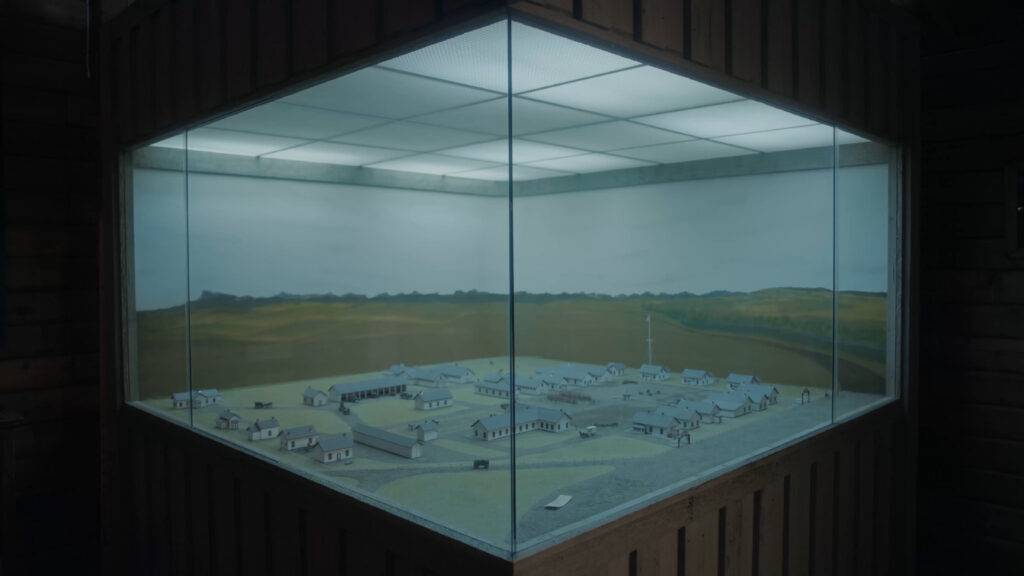
Alberta Number One Still (Museum) | Photo Credit: David Ehrenreich
That’s a perfect segue into something else that really stood out to me: the score. I found myself genuinely fascinated by the music, even if I don’t quite have the musical vocabulary to describe why. There’s that incredible saxophone work and all these different horn textures. How did you and Brodie approach crafting this score?
It started off with a conversation with Joseph Murray, who was one of the composers who did my first feature, O Brazen Age. I said that I wanted to do something different for this new one. I wanted to do something horn-based.
I very intentionally knew that we didn’t want to do a traditional Western score or a country-and-Western-influenced score. I wanted to do something jazzy and horn-based. Joseph asked if I knew Brodie West, and I didn’t, but I knew his music. His band, Eucalyptus, is one of our favourite local bands. It’s a magical experience to see those guys play live. Brodie had never done a score before, but Joseph said he would manage it. He would create the cues, Brodie can do the horns, and we’ll figure it out.
We actually edited the film with Eucalyptus as temp music, knowing what was coming down the line. We got so attached to the temp music that I thought there was no way these guys were going to produce something I’d love as much. Then they killed it with what they brought to the table. I was so delighted.
They were tapping into the fact that it is jazzy. It’s a little bit funky. It’s a little bit moody and mysterious at times. It’s also funny. It plays into some of the hard edits. It’s not a subtle score. It draws attention to itself as a layer of text complementing what’s happening with the characters or the museums or whatever other cinematic registers we’re playing on. They did a beautiful job.
North Country Cinema and 20 Years of Making Movies
Alberta Number One is currently rolling into select Canadian theatres, but Alexander Carson has already spent years carving out a space for himself within Canadian independent film, both through his own work and through the long-running collective North Country Cinema. With two features, a body of shorts, and festival runs at places like TIFF and the Chicago International Film Festival behind him, he’s hardly new to this world, even as his practice continues to evolve. I was curious what North Country Cinema represents to him at this point, how he balances his work, and whether new projects are in the works as the company hits the 20-year mark.
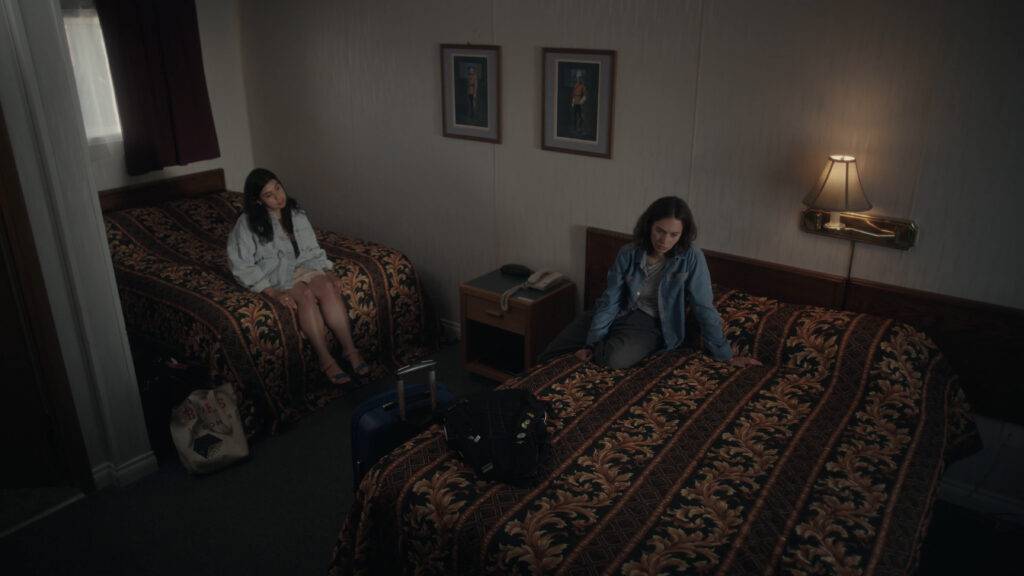
Alberta Number One Still (Motel) | Photo Credit: David Ehrenreich
That’s amazing, and it definitely feeds into that meta-textual feel. Just before I let you go, I wanted to circle back to North Country Cinema, which you mentioned earlier. Could you talk a bit about what North Country Cinema is to you at this point, and what you have on the go with the company right now?
Kyle Thomas is much more productive than I am. I’m the chair of a university program in Toronto, and I have an almost five-year-old and an almost three-year-old. So, to be honest, I’m not doing too much movie stuff right now. I’m just trying to keep things in balance here.
I am scheming on a project for the future that would be another Alberta-based project, a psychological thriller set on a golf course. I don’t want to say too much more now, but that is something on the horizon. It would be totally weird, but it would be a bit more of an exploration of genre than we have done previously, which could be worth looking into.
Kyle’s got a lot of projects in development. The company turned 20 this summer, so we’re taking stock and reflecting on how lucky we have been to make films for 20 years. Recently, we have made four feature films and have other projects in the pipeline, which has been incredible. Who knew? I met Kyle and Sarah the second week of my first year of university, and for better or worse, here we are 20 years later, still working together. It’s been a really rewarding experience.
It’s interesting to see the ways in which Kyle’s films and my films speak to each other. Very often, if he does something in a film, then I’ll do something similar but totally different. We’ll have back-to-back films with big funeral sequences in them for people, where the treatment is totally different, even if there’s a bit of overlap and intersection with the subject matter. There are lots of ways in which the work speaks to each other, and I feel very lucky to be able to continue making work with good people.
If you get the chance, you should get yourself to a theatre to see Alberta Number One. Recently acquired by Game Theory Films, it’s already making its way across the country and is even playing here in Calgary at the Plaza Theatre, complete with a Q&A.
It is a truly singular work from A to Z.


