

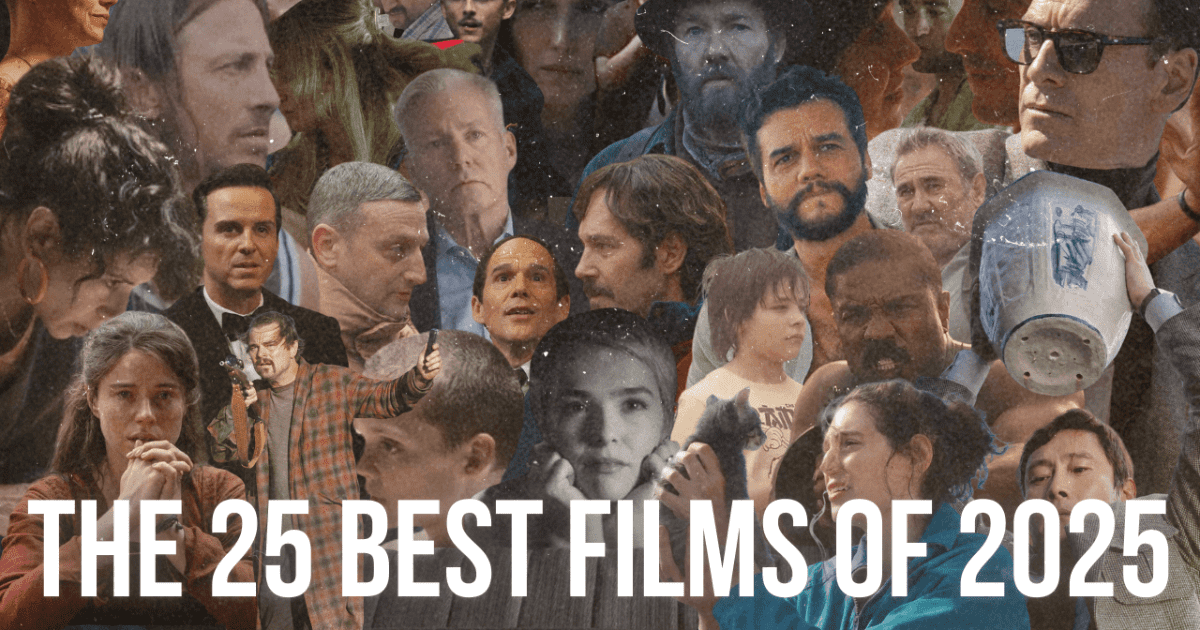

Top 25 Films of 2025
Another year, another “best of” list. These are the movies that hit me hardest in 2025 — the ones that will stick, formally and emotionally, long into 2026.
25. The Mastermind
Director: Kelly Reichardt
Starring: Josh O’Connor, Alana Haim, John Magaro, Gaby Hoffmann, and Bill Camp
The Mastermind is exactly the kind of film I want from Kelly Reichardt: she takes a heist setup and stretches it into slow cinema, where the “job” is basically a pretext for character. Don’t go in expecting pyrotechnics — there are traces of gunfights and car chases, but if you’re hoping for Michael Mann, you’re in the wrong movie. Reichardt builds the first half around small, almost casual choices, and then lets the whole thing collapse the way these schemes always do, because James has no real pivot and no instinct for consequences. If you can handle the pacing, it gets both funnier and sadder as it goes.
24. Bunny
Director: Ben Jacobson
Starring: Mo Stark, Ben Jacobson, Liza Colby, Henry Czerny, and Richard Price
Bunny is a festival film in all the best ways — scrappy, chaotic, and completely magnetic. It drops you into this East Village tenement building and just holds on tight, following Bunny, a beloved hustler having a truly awful day. We stay with him and his crew as they’re hiding dead bodies, dodging cops, and somehow still trying to keep the fragile ecosystem of their housing complex running like nothing’s wrong. What makes it work is the texture: characters crashing into each other in real time — Airbnb guests, estranged family, even a rabbi — and the movie keeps finding new ways to complicate the situation without ever feeling like it’s straining for “plot.” Jacobson doesn’t sand it down into an overly polished indie drama; he leans into the mess, and it pulls you into every moment.
23. Hallow Road
Director: Babak Anvari
Starring: Rosamund Pike, Matthew Rhys, and Megan McDonnell
Hallow Road is a tight, real-time thriller that never takes its foot off the figurative gas. The camera stays almost entirely inside a car with Frank, a stressed corporate fixer, and his wife Maddie, a paramedic, as they race toward the forest road that gives the film its name. Their daughter’s terrified voice crackles through the speakerphone, pleading for help from a remote stretch of woodland, and the drive forces these parents to face darker parts of themselves. Anvari makes a great formal choice here too: 16mm for the outside world, razor-sharp digital inside the car, turning the vehicle into a psychological prison for them — and for us. Stick around for the closing credits.
22. Bring Her Back
Director: Danny Philippou, Michael Philippou
Starring: Sally Hawkins, Billy Barratt, Sora Wong, and Jonah Wren Phillips
Bring Her Back is the Philippou brothers’ second film, and it’s strong proof they’re going to be mainstays in modern horror. It drops two step-siblings into a foster situation after a family death, and then slowly tightens the screws once Laura enters the picture. Sally Hawkins is incredible because she plays two things at once: the version of Laura that feels “off,” and the version that seems warm enough to make you doubt yourself. The sound work is nasty in the best way — not just loud scare chords, but specific, physical textures that get under your skin. Underneath it all, it’s grief horror: what people will do to avoid sitting with loss.
21. Friendship
Director: Andrew DeYoung
Starring: Tim Robinson, Paul Rudd, Kate Mara, Jack Dylan Grazer, and Meredith Garretson
Friendship had me laughing out loud in the theatre more than I have in years. DeYoung comes out of TV and short-form comedy, but he stretches that sensibility into something that feels bigger than a feature-length sketch — and getting Tim Robinson is basically the whole ballgame. If you know I Think You Should Leave, the humour is in that lane: absurdism, painful secondhand embarrassment, and a guy making everything worse by trying too hard. The key difference is that it isn’t just “bits.” You’re locked into one character for the whole runtime, so the desperation starts to feel weirdly intimate. And in the quieter moments, it gives you space to think about male loneliness and emotional repression.
20. Predators
Director: David Osit
Predators is understandably controversial — it’s a film about To Catch a Predator, but it refuses the easy distance that made that series feel “safe” to consume. Osit traces the show’s appeal to a simple moral vending machine: “good guys and bad guys,” where you, by sitting at home, get to be a good guy. Predators makes that posture impossible. Built from a huge cache of unaired material, it plays like emotional ping pong: disgust, then a flicker of sympathy, then recoil at your own reaction. It isn’t primarily a film about criminal acts. It’s about storytelling — who shapes the narrative, who benefits from it, and who pays. It is also about complicity: of institutions, creators, and of us, the audience.
19. Black Bag
Director: Steven Soderbergh
Starring: Michael Fassbender, Cate Blanchett, Naomie Harris, Pierce Brosnan, and Regé-Jean Page
Black Bag is the kind of taut spy thriller I’m not always first in line for — and still, Soderbergh has complete control. The premise is ruthlessly simple: George has one week to find the leak inside his intelligence organization, or tens of thousands of people die. The suspect list is essentially his social circle, including his wife, Kathryn, which turns the whole thing into an intimate pressure cooker. Soderbergh’s dinner-party “truth” exercise becomes a chess match, and the vibe is old-school espionage with modern texture, like drone strikes, satellite surveillance, and AI-eavesdropping. Fassbender and Blanchett elevate what could’ve been a standard thriller into something sharper and more unnerving.
18. The Secret Agent
Director: Kleber Mendonça Filho
Starring: Wagner Moura, Udo Kier, and Maria Fernanda Cândido
The Secret Agent is one of those films where you can feel the director’s hand in everything — not in a showy way, but in the sense that the movie has its own internal logic and refuses to translate itself for you. Set in 1977 Brazil under the dictatorship, it plays like a character study disguised as an espionage film: laid-back on the surface, constantly tense underneath. What really got me is how the film normalizes horror without flattening it — bodies appear, and people step around them; killers do their job and then go eat dinner; cops use Carnival chaos as cover. It’s novelistic, it’s weird, it’s precise — and if you let it pull you into its wavelength, it deepens as it goes.
17. Sirat
Director: Oliver Laxe
Starring: Sergi López, Bruno Núñez Arjona, and Jade Oukid
Sirat is one of the most visceral films of the year — a movie that starts as a desert rave and slowly reveals itself as a grief story set against the feeling that the world has already ended. Sergi López plays Luis, searching for his missing daughter with his son in tow, and the film uses that desperation as the entry point into this roaming community crossing the Sahara toward “one last party.” Formally, it’s gorgeous: painterly wides, 16mm grit, and a soundscape that makes the bass and the wind feel like the same force. Where it wobbles a bit is late — the metaphors get more literal — but even with that caveat, it’s a charged, singular experience about loss, community, and momentum when the future feels gone.
16. Together
Director: Michael Shanks
Starring: Alison Brie, Dave Franco, and Damon Herriman
Together exceeded almost all of my expectations and ended up being one of my favourites of the year. This debut feature follows a real-life couple relocating to the countryside as their relationship starts to unravel, and then it takes that fear — losing your identity inside a relationship — and gives it physical form through body horror. What I liked most is how Shanks weaves tone: genuinely unsettling, then awkwardly funny, without breaking the spell. The cinematography plays the same game: tight, shadowy interiors that suffocate, then bright exteriors that almost mock the idea of “space” and “freedom.” It’s scary, but it also understands the beauty in committed love, even while admitting how terrifying that commitment can feel.
15. Blue Moon
Director: Richard Linklater
Starring: Ethan Hawke, Margaret Qualley, Bobby Cannavale, and Andrew Scott
Blue Moon is Linklater doing what he does best: taking a simple setup and letting it turn into something painfully honest. We follow Lorenz Hart after he ducks out of Oklahoma!’s opening night and parks himself at Sardi’s, where the film unfolds in conversation. Hawke is world-weary and sharp and self-destructive, but he never plays Hart like a caricature — he’s the guy who can’t stop talking because silence would kill him. Margaret Qualley is wonderful as Elizabeth, the young woman Hart clings to as a last “maybe.” And when Andrew Scott arrives as Richard Rodgers, it becomes a film about partnership, abandonment, and that awful overlap between professional failure and personal longing.
14. Die, My Love
Director: Lynne Ramsay
Starring: Jennifer Lawrence and Robert Pattinson
Die, My Love is a “this won’t be for everyone” Ramsay film — and I mean that as a compliment. Lawrence and Pattinson move to the countryside with that romantic “we’ll make art, we’ll be free” fantasy, and Ramsay frames the whole thing as confinement: new motherhood, creative paralysis, intrusive thoughts, hope… collapse… repeat. The visuals do a ton of heavy lifting — the boxed-in framing makes it feel like the walls are always closing — and the sound design weaponizes absence as much as noise. It plays less like plot beats and more like intrusive thought patterns.
13. Bugonia
Director: Yorgos Lanthimos
Starring: Emma Stone, Jesse Plemons, and Alicia Silverstone
Bugonia is classic Lanthimos: super weird, and I liked it a lot. Teddy and Don are conspiracy guys convinced Earth is being infiltrated, so they go after a powerful executive they believe is the alien. Teddy being a beekeeper lets Lanthimos play with colony collapse as a running metaphor for human civilization, and it fits the film’s paranoia perfectly. What put it over for me is how Lanthimos shoots discomfort — the compositions feel “wrong” in a way that mirrors Teddy’s disarray. It’s uneasy, funny, and deeply committed to the paranoia.
12. The Perfect Neighbor
Director: Geeta Gandbhir
The Perfect Neighbor was my favourite documentary of the year, and I’m genuinely grateful I stumbled into it. It takes a familiar subject — guns, “Stand Your Ground,” the endless American loop of outrage and inertia — and tells the story primarily through found footage: bodycams, security video, phone recordings. The result is a month-by-month escalation that feels both specific and depressingly familiar. It doesn’t lecture you. It shows you a system, lets you sit in the repetition, and lets the dread accumulate. By the end, it’s saying something enormous about inevitability — not as fate, but as policy.
11. Nouvelle Vague
Director: Richard Linklater
Starring: Guillaume Marbeck, Zoey Deutch, and Aubry Dullin
Nouvelle Vague is one of those movies where, whether you love it or not, I have a hard time believing any real cinephile walks out with nothing. Formally, it’s impressive: the black-and-white photography feels period-authentic, and the film’s big irony is that it uses modern tools to recreate a moment defined by making greatness without money or manpower. It’s breezy, funny, and deeply inside-baseball — a making-of that plays best if you already know what Breathless is and why it mattered. It’s not Breathless, but it’s a loving portrait of the messy way Breathless happened, and the long shadow it cast.
Top 25 Films of 2025
10. No Other Choice
Director: Park Chan-wook
Starring: Lee Byung-hun, Son Ye-jin, and Park Hee-soon
While Park Chan-wook may never be able to quite replicate what he did with Oldboy, No Other Choice might be the closest he has come. Lee plays Yoo Man-su, a guy with a comfortable life that gets yanked out from under him, and you can feel the panic turn into something uglier: pride, entitlement, and that fragile breadwinner identity curdling into violence. What I loved is how Park keeps finding comedy inside the horror without defanging it. Scenes that should play as pure thriller beats start drifting into awkward domestic absurdity. It might run a touch long, but it’s wickedly entertaining, and Lee’s performance does a ton of heavy lifting without ever begging for sympathy.
9. Train Dreams
Director: Clint Bentley
Starring: Joel Edgerton, Felicity Jones, and William H. Macy
Train Dreams is a beautiful reflection on life and love, and loss, and it comes from a team that’s clearly on a roll. Bentley is at the helm, with a script co-written with Greg Kwedar, and the film moves with this quiet confidence — like it trusts you to feel what it’s doing without forcing anything. Visually, it’s gorgeous, and it keeps showing up in “best cinematography” conversations for a reason. Edgerton gives a magnificent performance: tough and quiet on the surface, with a tremendous amount hidden underneath. It becomes a story of realizing too late what you had, and slowly crushes you (in the very best way).
8. Marty Supreme
Director: Josh Safdie
Starring: Timothée Chalamet, Gwyneth Paltrow, Tyler, the Creator, and Odessa A’zion
Marty Supreme is an absolutely wild ride. This is Safdie fully back in that Uncut Gems lane — the pacing can meander, and then it smacks you directly in the face when you least expect it. A lot of the conversation will revolve around Chalamet, and he’s been doing a brilliant job marketing the film, but I was arguably even more impressed by the supporting work. Tyler, the Creator is truly exceptional, and the cast around him keeps the film unpredictable. The Safdie/Ronald Bronstein pairing is such a good fit. You can feel the craft behind the madness.
7. It Was Just an Accident
Director: Jafar Panahi
Starring: Vahid Mobasseri, Mariam Afshari, and Ebrahim Azizi
It Was Just an Accident nails confinement from the opening frames. Characters are locked into tight compositions — stuck inside cars, squeezed into a central van — and it all underlines that trapped condition under the Iranian regime. Then Panahi contrasts it with the desert: wide and expansive, “free” in theory, but it reads like a different kind of prison — endless space, no direction, faux freedom. Tonally, it uses levity as a false safety net: fleeting pockets of humour that lull you, and then the confrontations land harder. The pacing is deliberate, with long takes that let tension build in real time. And the ending is one of the strongest of the year.
6. Hamnet
Director: Chloé Zhao
Starring: Jessie Buckley, Paul Mescal, Emily Watson, Joe Alwyn, and Jacobi Jupe
Hamnet feels like Chloé Zhao working in her lane again — high-profile, sure, but grounded and deeply human. What surprised me most is how hard the film hits in its second act; I expected the emotional peak to be saved for the end, but it gets you early, and it comes down to the siblings. The child performances are doing an absurd amount of heavy lifting, and it works because the film treats grief like something lived, not performed. Jessie Buckley and Paul Mescal are both strong, but the real power here is the way the film understands family as a fragile ecosystem. You can debate historical accuracy if you want, but that’s not the point. It’s about love and loss, and it lands.
5. One Battle After Another
Director: Paul Thomas Anderson
Starring: Leonardo DiCaprio, Sean Penn, Benicio del Toro, Regina Hall, and Teyana Taylor
One Battle After Another is PTA making something messy, funny, and technically fascinating — and for me, it lands way better than Licorice Pizza. The cast is remarkable, led by DiCaprio, who is essentially unable to give a poor performance. The movie’s a wild ride, and that final-act chase is one of the best sequences of the year, full stop. The visuals are a huge part of why it plays the way it does: the look is messy on purpose, rule-breaking in a way that matches the film’s energy. It’s also one of the sneaky funniest films of the year — hyperbolized, chaotic, and still incredibly crafted.
4. Sorry, Baby
Director: Eva Victor
Starring: Eva Victor, Naomi Ackie, and Lucas Hedges
Sorry, Baby is one of the most confident debuts I’ve seen in a long time. It’s structured in five chapters across five years, and it tracks time through small details: shifts in space, in routine, in the way Agnes carries herself. Victor writes, directs, and stars with quiet, self-assured control; you can feel how carefully the film is built, even when Agnes is falling apart. The dry humour keeps cracking through in these little pockets of light, but it never undercuts the pain. It’s an emotionally precise film — patient, honest, and devastating in a way that sneaks up on you.
3. If I Had Legs I’d Kick You
Director: Mary Bronstein
Starring: Rose Byrne, Conan O’Brien, and Christian Slater
If I Had Legs I’d Kick You is the strongest psychological thriller of 2025. The premise is simple — Linda is trying to keep her life together while her daughter’s medical needs and a literal hole in the ceiling keep widening — but the execution is ruthless. Bronstein holds you in discomfort, and the framing makes every conversation feel like a trap. What I love is how it blends the surreal and the real without signalling when it switches lanes; it just lets the anxiety take over. Byrne is operating on another level here.
2. Sinners
Director: Ryan Coogler
Starring: Michael B. Jordan, Hailee Steinfeld, Jack O’Connell, Wunmi Mosaku, and Delroy Lindo
Sinners is the kind of big, audacious studio swing that I don’t usually rank this high — and yet I can’t shake it. Set in 1932 Mississippi, it filters vampire horror through the sound and sweat of the blues, and it treats music like something sacred. The juke joint sequence is genuinely one of my favourite scenes of the year: it feels like the room expands, ancestors and future generations bleeding into the same moment. The photography is bold and tactile, constantly alive to faces and bodies in motion, and it’s the kind of film that demands a big screen. By the end, it becomes a film about legacy — what hurts, what heals, and what gets carried forward.
1. Sentimental Value
Director: Joachim Trier
Starring: Renate Reinsve, Stellan Skarsgård, Inga Ibsdotter Lilleaas, and Elle Fanning
Sentimental Value was everything I needed it to be and more. Coming off The Worst Person in the World, this feels like Trier at the very top of his game — and for me, it’s an even better film. The script, co-written with Eskil Vogt, is truly brilliant: it takes family dynamics that sound simple on paper and slowly reveals how much is actually going on underneath. The cast is a huge part of why it works, and every character feels three-dimensional without any one person completely dominating the runtime. It’s heartbreaking in a very human way — about how pain shows up differently in different people, and how often we have no idea what someone is carrying.


