


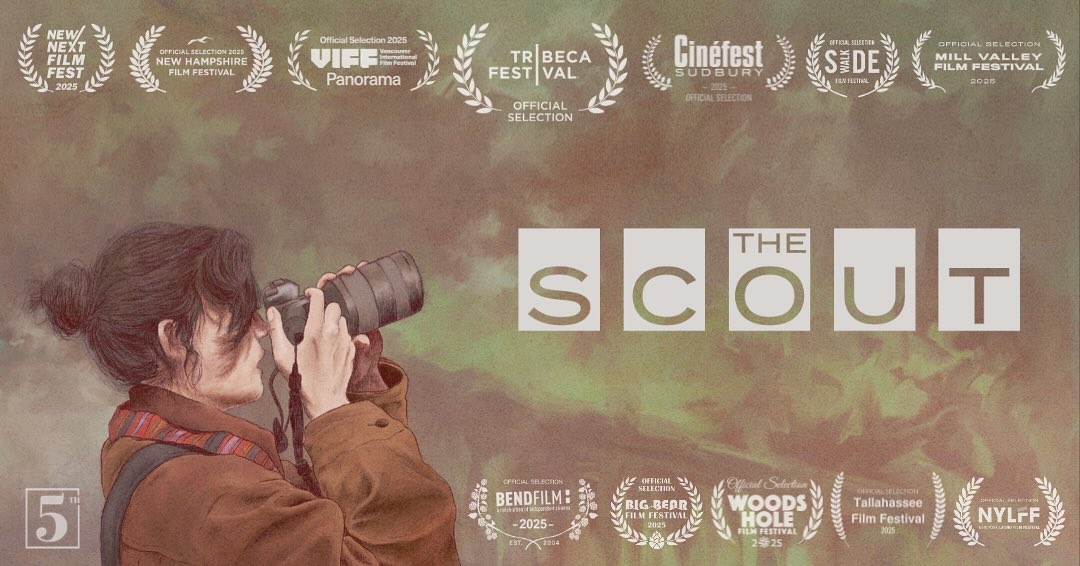
The conversation around The Scout began, at least for me, as an extension of the Calgary Underground Film Festival. Paula Andrea González-Nasser was not able to attend the festival in person, but I was able to catch up with her virtually afterwards, which felt appropriate in its own slightly strange way. The Scout is a film about moving through the world at a distance. It is about brief encounters, temporary access, and the slightly surreal intimacy of entering another person’s space before leaving it again.
It also feels like a fitting moment to return to the film, as I am in the middle of writing my preview for the 2026 Tribeca Festival, and The Scout is now nearly a year removed from its world premiere at the 2025 Tribeca Festival. In that sense, the film sits between two festival conversations for me. It arrived in New York last year, came through Calgary this spring, and now exists in that interesting post-festival space where a small independent film begins trying to find its way toward a broader audience.
CUFF is, of course, a festival where the loud, strange, grotesque, and genre-adjacent often have room to breathe. That is one of the pleasures of the festival. You can move from horror to bodily decay to absurdist comedy to something that feels like it might have crawled out of a basement no one should have opened. In that context, The Scout may not seem, at first, like the most obvious fit.
But that is also why it felt necessary.
There is value in the films that jolt you. There is also value in a film that asks you to sit, look, and be patient; to pay attention to the spaces between dramatic events, where a different kind of pressure slowly gathers. In a festival filled with bodies breaking down, people spiralling out, and genre films pushing against the edge of taste and comfort, The Scout offered a different kind of unease.
That is part of why it made sense alongside something like Bagworm, another CUFF selection I wrote about this year. On the surface, the two films could hardly be more different. Bagworm follows a sexually frustrated hammer salesman whose physical and psychological world begins to rot around him. The Scout follows a location scout through one day in New York as she tries to lock down spaces for a television pilot. One film moves through grotesque decay. The other moves through apartments, businesses, doorways, and the awkward intimacy of professional small talk.
And yet, both are character studies. Both are deeply internal. Both are about people whose work, surroundings, and sense of self have fallen into some kind of disarray. In my conversation with Oliver Bernsen about Bagworm, he described the film not simply as an external descent into mayhem, but as a story about a man at a low point in his life, unable to properly face the way his own state has infected his view of the world. That is not so far away from what The Scout is doing, even if its methods are radically different.
There is also a literal connection between the two films. Nick Nazmi, who appears in the opening scene of The Scout, edited Bagworm.
“Nick Nazmi, who’s in the opening scene of The Scout, is their editor,” she told me. “Nick had been working on it. He was like, ‘This movie I’m editing is intense”…and then it’s Bagworm. It is a small world.”
That small-world quality is not incidental to this kind of filmmaking. It is often the condition that makes it possible. People move between projects not just as names in the credits, but as members of overlapping creative communities, carrying relationships, favours, instincts, and hard-earned trust from one film to the next.
What is The Scout About?
When I asked Paula to describe The Scout in her own words, she began with structure.
“So, The Scout came about as a collection of stories,” she told me. “I wanted to follow a character through a one-day journey in New York City.”
That character is Sofia, played by Mimi Davila, a location scout trying to secure spaces for a television pilot that is about to shoot in New York. Over the course of a single day, she moves through homes, businesses, and streets, meeting strangers and old acquaintances, trying to persuade them to allow a production into their spaces. On paper, this could sound almost procedural. A woman has a job. She goes from place to place. She tries to complete that job.
But The Scout is not really about the mechanics of location scouting, even though it pays close attention to them. It is about what that job reveals. Sofia is always entering spaces, but rarely belonging to them. She is welcomed in, sort of, but only for a purpose. She is expected to observe, photograph, assess, negotiate, and move on. She is intimately present and fundamentally temporary.
That contradiction gives the film its shape. The job requires connection, but it also produces distance. It asks Sofia to move through the lives of others, gathering fragments, while her own sense of equilibrium quietly erodes. She speaks to people in their homes, sees their furniture, their artwork, their routines, their loneliness, their pretensions, their private rituals. And then she leaves.
The film unfolds almost like an anthology of encounters, but the encounters are not there to create a neat set of lessons. They are there to gradually reveal the human behind Sofia’s fragile facade. Because she is so reserved, the people around her have to pull things out of her. They become pressure points. Some are tender. Some are strange. Some are uncomfortable. Some are funny in the slightly painful way real interactions often are.
That restraint is one of the film’s great strengths. It does not try to explain Sofia all at once. It lets us watch how she responds to rooms, people, delays, requests, and never-ending parking tickets.
That places enormous weight on Davila, who has to carry much of the film without turning Sofia into a closed door. Paula had Davila in mind from the beginning, though she did not tell her right away.
“With casting, I’m so unable to write without an actor in mind,” Paula said. “I had always had Mimi in the back of my mind.”
She had worked with Davila on a short film years earlier, but this role was very different. In real life, Paula described Davila as loud, excitable, and comedic, which makes her screen performance here even more impressive. Sofia is internal, observant, and guarded. Yet Paula saw a particular duality in Davila.
“She can be really joyous and then very sad with her eyes,” she said. “She reminds me of Monica Vitti a little bit, in her ability to portray someone without saying much.”
That is exactly what The Scout needs. It is not a film that could survive a hollow centre. The subtlety of her performance allows Sofia to remain difficult to read without becoming inaccessible.
Writing What You Know, Then Throwing Reality Away
There is an obvious biographical entry point into The Scout. Paula previously worked as a location scout on New York films and television shows, including High Maintenance, Russian Doll, Search Party, and Never Rarely Sometimes Always. So it would be easy to describe this as a simple case of writing what you know.
That is true, but only to a point.
When Paula first sat down to write what she hoped would be her first feature, The Scout was not the plan. She had been working through two larger ideas that were harder to place. She needed, as she put it, “some sort of container.” That container arrived through Chantal Akerman.
“One day, I watched Chantal Akerman’s The Meetings of Anna, and structurally that film gave me so much excitement,” she said. “It was like, oh, you can do that. That’s a structure you can follow.”
That structure brought her back to scouting. At first, she resisted the idea. Making a movie about her own experiences as a location scout sounded, to her, almost embarrassing.
“If you had told me that I would make a movie about my experiences scouting, I would have scoffed and laughed and been like, that’s so cringe. Why would I ever do that?” she said.
But Akerman’s film gave her a way in. It showed her how a segmented structure, built around encounters, could reveal loneliness and alienation. Scouting is, by nature, a socially dependent job. It requires constant interaction. Yet the experience of doing it can be deeply solitary.
That is where the film begins to become more interesting than autobiography. Paula did not simply transpose her own life onto the screen. In fact, she found that the more literal she was, the less the script worked.
“The first few drafts that I wrote of this film had a lot of my actual experiences in it,” she said. “I would show them to trusted collaborators, and they would be like, yeah, it’s maybe not working yet. And I would be like, I don’t get it. This actually happened to me. Why isn’t it working?”
Of course, the fact that something happened does not automatically make it dramatically useful. Reality has no obligation to serve a story. Sometimes the truer artistic choice is to step away from the literal event and find the emotional structure underneath it.
“Just because something actually happened and is based on truth, it doesn’t mean it’s right for the story or that it’s serving the purpose of the story,” she said.
So she threw some of that reality away. She shaped the side characters into fictionalized versions of people she had met, or people carrying attributes of people she had met. The goal was not transcription. It was pressure. Each encounter needed to reveal something about Sofia by pushing or pulling her in a slightly different direction.
That is a more useful understanding of “write what you know.” It does not mean you are only allowed to recreate things that happened to you. It means you begin with a lived understanding of a world, then give yourself creative permission to distort, refine, and fictionalize until the story becomes, counterintuitively, even more truthful than it would’ve otherwise been.
The Scout and Finding Frames Within Frames
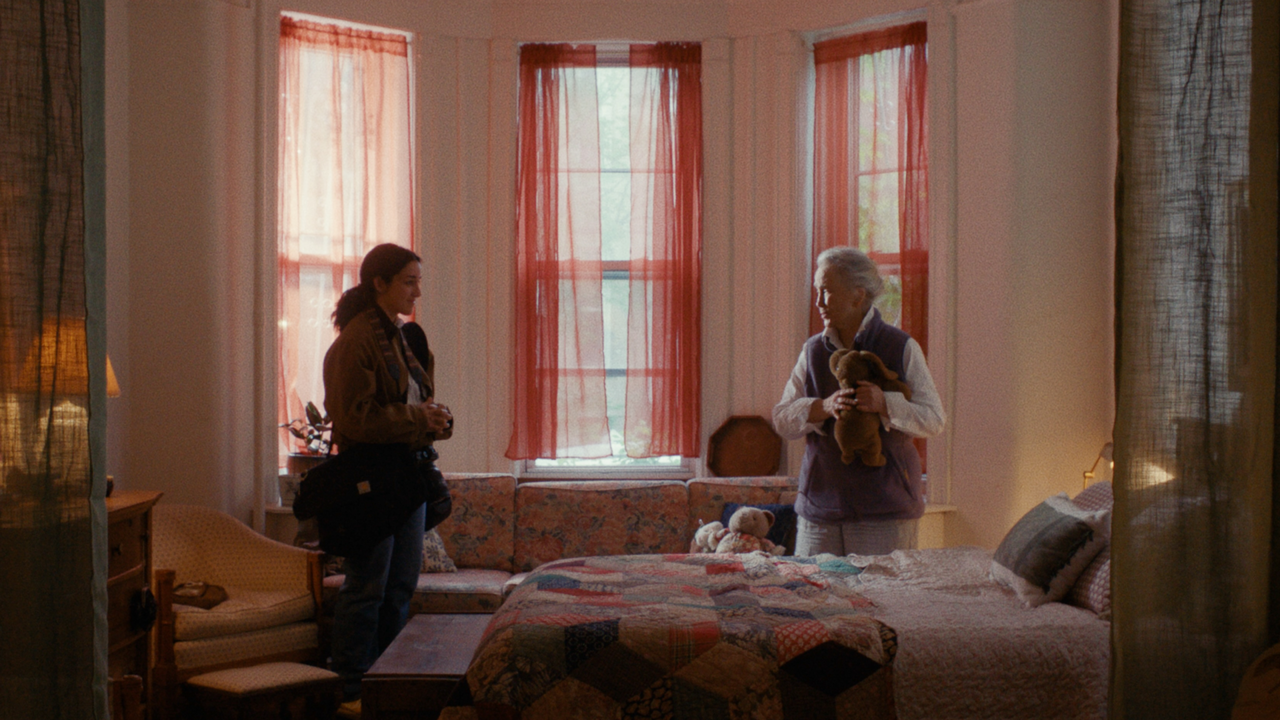
The first thing I wanted to talk to Paula about, after the premise and the writing, was the visual language. The Scout is a film of rooms, thresholds, windows, doors, hallways, and leading lines. On the surface, the images can appear simple. The camera is often locked off. The compositions are clean. The film is not trying to overwhelm you with movement.
But the simplicity is deceptive. The frames are built with remarkable care.
This is, in many ways, a film about frames within frames. Sofia is constantly being placed inside architectural spaces that seem to define her before she can define herself. Buildings, doorways, windows, shelves, staircases, and hallways do not merely surround her. They organize her. Sometimes they trap her. Sometimes they offer a narrow passage out of an uncomfortable situation. Sometimes they make the space around her feel both beautiful and constricting.
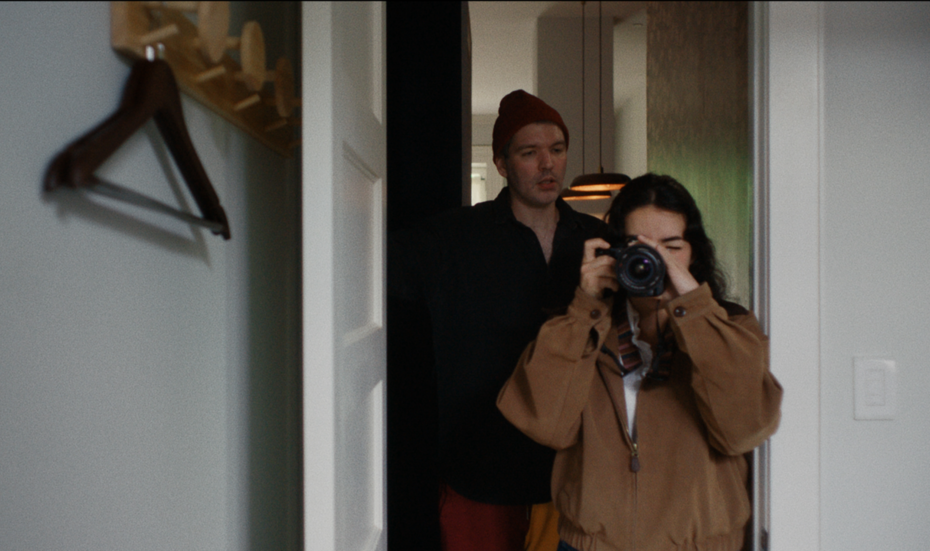
This makes for frames that are both beautiful and deeply significant. The Scout is about a person whose job is to look at spaces as potential images. Sofia is not just entering apartments. She is evaluating them. She is imagining how they might appear on screen, how they might serve another story, how they might become useful to someone else’s production. The film’s visual language mirrors that way of seeing. It is showing us a character whose relationship to the world has become mediated by the act of scouting.
A great deal of that comes through Nicola Newton‘s cinematography, and Paula was quick to credit her.
“I love talking about Nicola,” she said. “I jokingly say — and this is not to shoot my own work down — that the reason this film works is because of Mimi and Nicola.”
Paula has known Newton for about fifteen years. They were classmates at Florida State University, and Paula had previously worked with her as a producer and production designer. But The Scout was their first feature collaboration with Paula directing and Newton shooting.
What she described was not simply a technical relationship, but a shared way of looking. Newton has a photography background, and Paula said she is constantly wandering off to take pictures when they are together. That instinct became crucial to a film about someone whose work involves turning lived spaces into images.
“It mirrors how I wanted to portray the visuals in this very specific movie, which has such a weight on how the scout views the world and how the creatives receive the visuals from her work,” Paula said. “It’s a very metatextual element.”
The spaces in The Scout tell us about people before the dialogue does. That is one of the reasons the film can remain so restrained. The rooms carry information. The artwork, furniture, emptiness, clutter, polish, or discomfort of a space becomes a kind of character description. Rather than forcing the supporting characters to explain themselves, the film lets us deduce things about them by looking at where and how they live.
“By photographing things this way, you learn so much about the characters without having to do that through expositional dialogue,” Paula said.
That is also why the leading lines in the film feel so important. They are beautiful, yes, but they are not merely decorative. They tell us how Sofia is moving through the day. They show us paths, limits, exits, and dead ends. They make the city feel like a system of possible images, but also a system of pressures.
The Difficulty of Standing Still
I have a real appreciation for filmmakers who are willing to lock off the camera. There is a time for movement, of course, but there is also something refreshing about a film that is comfortable holding a frame.
That choice can be mistaken for simplicity. In practice, it is often the opposite.
Paula said that before making the movie, she would have described the locked-off style as both intentional and practical. She loves filmmakers with composed, observational photography: Michelangelo Antonioni, Akerman, and, at times, Wim Wenders. Given the scale of the production, a restrained visual approach may also have seemed manageable.
Then they actually made the film.
“What we found in shooting this is that locking things off actually made it a lot more difficult,” she said. “We needed to have a lot more experience in lighting these types of shots and blocking the characters within them.”
That is one of the quiet paradoxes of this kind of filmmaking. Handheld work can sometimes cover a multitude of problems. It can move with the actor, adjust to energy, and hide imperfect lighting. A locked-off frame is less forgiving. If the blocking is wrong, you feel it. If the lighting is wrong, you feel it. If the actor lands in the wrong place, the composition almost always feels “off”.
Paula said they often had only six or seven shots per day, but each one took time to set up properly. The framing might come together quickly, but lighting the frame and making the movement inside it feel organic was much harder.
That led to one of the more human moments in our conversation. She had already mentioned blocking, which set up my next question almost too perfectly. I told her I had assumed there must have been extensive blocking because the frames were so precise. Her answer, though, came with a laugh.
“Lessons learned,” she said.
Davila had suggested that she not meet the actors playing the characters Sofia encounters until the day of the scene, so that the awkwardness of those first meetings would feel real. Paula loved the idea.
But it also made the formal challenge harder.
“I underestimated how helpful blocking rehearsals would have been for this exact purpose,” she said. “I had not shot things in this sort of way before, and I didn’t really understand how much you need to plan the blocking so that it feels natural and doesn’t feel staged.”
That tension is visible in the best possible way. The film feels precise, but not dead. Davila brings little improvisational shifts in movement and dialogue, and those moments keep Sofia alive inside the highly curated compositions. But with this visual style, everyone has to remain in sync. The actor’s freedom, the camera’s stillness, and the scene’s emotional rhythm all have to find the same frequency.
And that is much harder than it looks.
It is also part of why The Scout feels, in its own quiet way, ambitious for a feature debut. First-time filmmakers are often tempted toward the bold and brash. That can be exciting, but it can also become a way of distracting from the actual story. The Scout does something potentially riskier. It makes the audience sit with a character whose changes are slight, internal, and difficult to articulate. It holds shots. It lets scenes breathe. And there is confidence in that, which often goes underappreciated.
The Community Labour of The Scout
These risks were made less dangerous as a result of the incredible community behind the project. The Scout is Paula’s feature directorial debut, but it is not the work of someone arriving alone. It emerges from a network of collaborators who have been making films with and for each other for years.
That began at Florida State, where Paula, Ryan Martin Brown, Newton, and others all studied in the same program. As Paula described it, the program was small, with only about twenty-five to thirty students per class. Everyone made films, and everyone had to work in different roles on one another’s sets.
“It’s beautiful because you learn all the things that maybe never interested you, like sound or art, but you learn how to do them,” she said. “You gain such an appreciation for those roles and learn how much work it takes to do those things.”
After school, that turned into a practical model for making independent work. Paula and Brown co-founded 5th Floor Pictures as a film collective, and the ethos seems to be built around what she called “sweat equity.” People contribute labour to one another’s projects because that is how the films become possible.
Paula produced Brown’s Free Time, which also played CUFF. Brown then produced The Scout, while also serving as first assistant director and co-editor. Newton, another longtime collaborator, became the film’s cinematographer. Byron Leon, another FSU classmate who edited Free Time, eventually came onto The Scout as a second editor.
This is not just a charming behind-the-scenes detail. It is central to how good films are often made now, especially outside the protective machinery of larger budgets. Communities of filmmakers build trust over time. They trade labour. They learn one another’s instincts. They step into multiple roles. They help carry the project not because the conditions are perfect, but because the relationships make the work possible.
“I think it was born out of necessity,” Paula said, “but now I’m realizing that I wouldn’t want to make a film without the support of the people whose journey I have also been part of.”
When you have been part of someone else’s process, you understand how they work. You know what they are good at, what overwhelms them, where they need support, and where they need space.
That connects The Scout back to Bagworm and to so much of the independent work that feels alive right now. These films are not waiting around for permission. They are being made by people who understand that the permission may never arrive, and that the only way forward is often through the people already around you.
Finding the Cut
The same trust carried into the edit, which is crucial in a film like this. If The Scout cuts too quickly, it loses the observational patience that makes it distinctive. If it holds too long, it risks losing the audience entirely. The film is built on a fine line between stillness and drift.
Paula was deeply involved in the edit. Brown was there from the beginning, but after the second rough cut, they brought in Leon. This proved to be essential because Brown and Leon had entirely different instincts, which meant that when they came together, it was clear that things were “right”.
“Sometimes we were all at odds with what a moment needed, how long to hold on a moment, or when to leave a scene,” Paula said. “But I think all of our different instincts provided almost like a fourth answer.”
Paula also described herself as an emotional editor rather than a technical one. She would feel the energy inside a shot and know, sometimes without being able to fully explain why, that the moment was finished.
“I love to see a moment, and sometimes I don’t know how to explain it, but I feel the energy within a shot and decide, guys, I think this moment is dead, and we need to leave it,” she said.
Paula pointed to a long shot of Sofia alone in her neighbour’s apartment, trying on clothes, as one of the moments where finding the exit point was especially challenging.
“But it was really fun because it was almost like making music in a way,” she said. “It’s instinctual and emotional.”
Then came the metaphor that feels almost too fitting for this kind of work.
“When those moments happened in the edit, it felt really cool,” she said. “It was like we were in a band.”
I said that in a band, you don’t have to say what you are playing. You just come together.
“Exactly,” she said. “You just play, and then you find a sound, and you follow that through. The melody carries the backbone of the film without being able to explain it, I guess.”
The Scout has a melody and a rhythm. It comes from arrivals and departures, waiting and rushing, looking and withdrawing. It is a film of repeated motions that slowly gather emotional weight.
No Clean Resolution
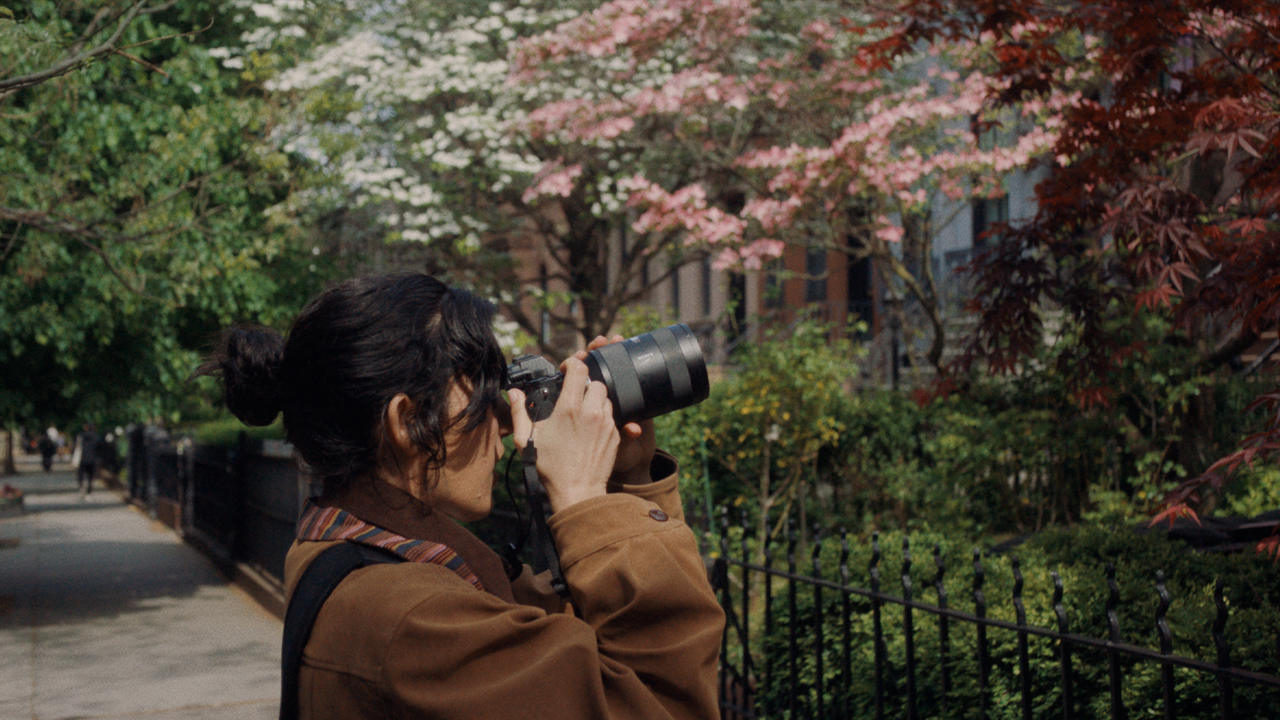
Another choice I admire in The Scout is its refusal to give complete closure to the people Sofia encounters. Each supporting character brings a different energy into the film. Some scenes are funny. Some are awkward. And some bring with it a history that we only get a brief glimpse into.
That could frustrate some viewers, as it is only natural to want resolution, and Paula even admitted that she wants resolution in her own life.
“In my personal life, I love resolution, and I need resolution,” she said. “But I wanted to show that, in real life, you don’t always get resolution.”
That is especially true for a job like Sofia’s. She meets people, enters their spaces, learns some small piece of who they are, and then often never sees them again. Even when the encounter is intimate or strange, it remains temporary.
“You think about them sometimes,” Paula said. “You’re like, I wonder where this person is. I wonder what happened to that person. But the reality is that you never see those people.”
The same is true, in a different way, of adult friendships. You do not always get a final conversation. You do not always know when the last meeting is the last meeting. Sometimes people just fall out of your life, through time, distance, avoidance, or the simple difficulty of maintaining connection.
The supporting characters remain unresolved because Sofia’s relationship to them is unresolved. They pass through the day. They affect her. Then they are gone.
As Paula described them, they are simply “ships sailing in the night.”
Hurry Up and Wait
Near the end of our conversation, I asked about time. I am always drawn to the way films handle time, and The Scout is quietly obsessed with it. Time appears explicitly in dialogue, but it is also embedded in the form. The film moves slowly, but Sofia’s day often feels urgent. She is waiting constantly, but also running out of time.
Paula immediately understood.
“I also feel very attached to the idea of time,” she said.
For her, the idea was tied directly to the film’s slow, observant frames. Our days often feel hectic when we remember them, especially in a place like New York. But if you actually break a day down, so much of it is waiting. Waiting for someone to answer. Waiting to get into a space. Waiting for the next thing to begin. Waiting, and then suddenly having to move.
“I like to use the phrase hurry up and wait,” she said. “That feels like a day in New York, where there is a lot of downtime, or moments when you’re waiting, and then you have to go, go, go, and everything feels rushed.”
That is the temporal structure of The Scout. It does not present the city as a nonstop adrenaline machine. It is not trying to create the feeling of constant crisis. Instead, it captures the strange rhythm of modern work, where nothing is happening until everything is happening, and where the in-between moments may be the most revealing parts of the day.
“I was interested in capturing what happens in those moments where there’s not a lot going on,” Paula said. “I’m interested in those moments of the everyday, when nothing’s happening. To me, that passage of time is life.”
That may be the key to the film. The Scout is not interested only in the dramatic peaks. It is interested in the connective tissue of a life. The pauses. The small embarrassments. The rooms you enter for ten minutes and never see again. The old friend who is not really an old friend anymore. The moment when you realize that the thing you thought was simply your job has become a way of living, and maybe not a sustainable one.
What Comes Next

The Scout had its world premiere at the 2025 Tribeca Film Festival, and Greenwich Entertainment has since picked up the film, and it is expected to be released theatrically later this year.
Greenwich’s recent and upcoming slate gives some useful context for the company now bringing The Scout to audiences, with films such as Free Solo, Linda Ronstadt: The Sound of My Voice, Coup!, Close to You, The Critic, Bonjour Tristesse, Love, Brooklyn, Dreams, and Omaha sitting within its broader catalogue.
For Paula, though, the film is not entirely behind her yet.
“Emotionally, I’m still tied to finishing this film in a lot of ways,” she said.
She is also sitting in on the edit for Ryan Martin Brown’s second feature, continuing the same cycle of collaboration that helped make The Scout possible.
“For the time being, I’m processing and getting my lessons learned from The Scout — what I want to take from it and what I don’t want to take from it — and trying to get better at writing, which is so hard,” she said. “I’m like, how do people do this? This is the hardest thing.”
There is something refreshing about that admission, especially coming after a debut this controlled. The Scout is not the work of someone pretending to have mastered everything. It is the work of someone looking carefully at the world she knows, discovering what does and does not serve the story, trusting her collaborators, and finding a form precise enough to hold a very quiet kind of uncertainty.
That uncertainty is what stays with me. The Scout is a film about work, but also about “looking”. It is about how we move through other people’s lives, what we notice, what we miss, and what we carry away without fully understanding it. It is about the odd intimacy of spaces. It is about the loneliness of a job that requires constant interaction. It is about the moments where nothing is happening, except that life is happening.
And in a festival environment where so many films find their power through violence or spectacle, there is something deeply valuable about a film that found its force in patience.
Sometimes you need the movie that breaks the room open.
Sometimes you need the one that asks you to sit still inside it.


