



Honey Bunch Film Review: A Meta Relationship Thriller
Madeleine Sims-Fewer and Dusty Mancinelli are the filmmaking duo best known for their uncompromisingly brutal debut, Violation, which premiered at TIFF and Sundance before finding a dedicated home on Shudder. With their latest feature, Honey Bunch, they show the suffocating, hazy boundaries of a relationship on the brink of collapse.
It brings a terrifying interrogation of intimacy to an antiseptic nightmare, weaponizing the comfort of a long-term partnership to ask unsettling questions about the conditionality of love.
Crucially, this is a film about relationships made by people in real-life relationships. You have Sims-Fewer and Mancinelli behind the camera, and the real-life couple of Grace Glowicki and Ben Petrie at the centre of the frame. It feels like an extension of the collaborative relationship we saw in Glowicki and Petrie’s films from last year, Dead Lover and The Heirloom.
There is a further sense of community beyond our leads as well, with folks like Director of Photography Adam Crosby and Composer Andrea Boccadoro continuing their nearly decade-long collaboration with Sims-Fewer and Mancinelli, plus someone like editor Lev Lewis, who also cut Grace Glowicki’s Dead Lover last year.
Ultimately, then, we can see Honey Bunch as an ecosystem that thrives when artists build with trusted collaborators.
(Side note: A huge congratulations are in order for Ben and Grace, who recently welcomed a child. Get this baby a camera… or a notebook… or an agent?)
What is Honey Bunch About?

Grace Glowicki (DIANA), Ben Petrie (HOMER), © 2025 Cat People
The film follows Diana (Grace Glowicki), a woman who wakes from a coma with her memories fractured and her sense of self eroded. Her husband, Homer (Ben Petrie), transports her to an experimental trauma centre. There, under the watchful and perhaps too-calm eye of the facility’s head of staff, Farah (Kate Dickie), Diana undergoes a regimen of sensory treatments—salt, strobes, and silence—intended to restore her fractured mind.
This setup is common—recalling the dread of a film like A Cure for Wellness—but the directors pivot the focus inward. The mystery is not just where Diana is, but who she is in relation to Homer.
As fragments of memory return, the film reveals itself not as a puzzle to be solved, but as a descent into the instability of intimacy.
The deeper Honey Bunch goes, the less it plays like a straightforward mystery and the more it becomes a study of relational power. It explores the emotional mechanics of a relationship: the stories we tell ourselves about “the one,” the things we justify in the name of commitment, and the fine line between caretaking and possession.
Mixing Comedy and Horror: The Glowicki-Petrie Dynamic
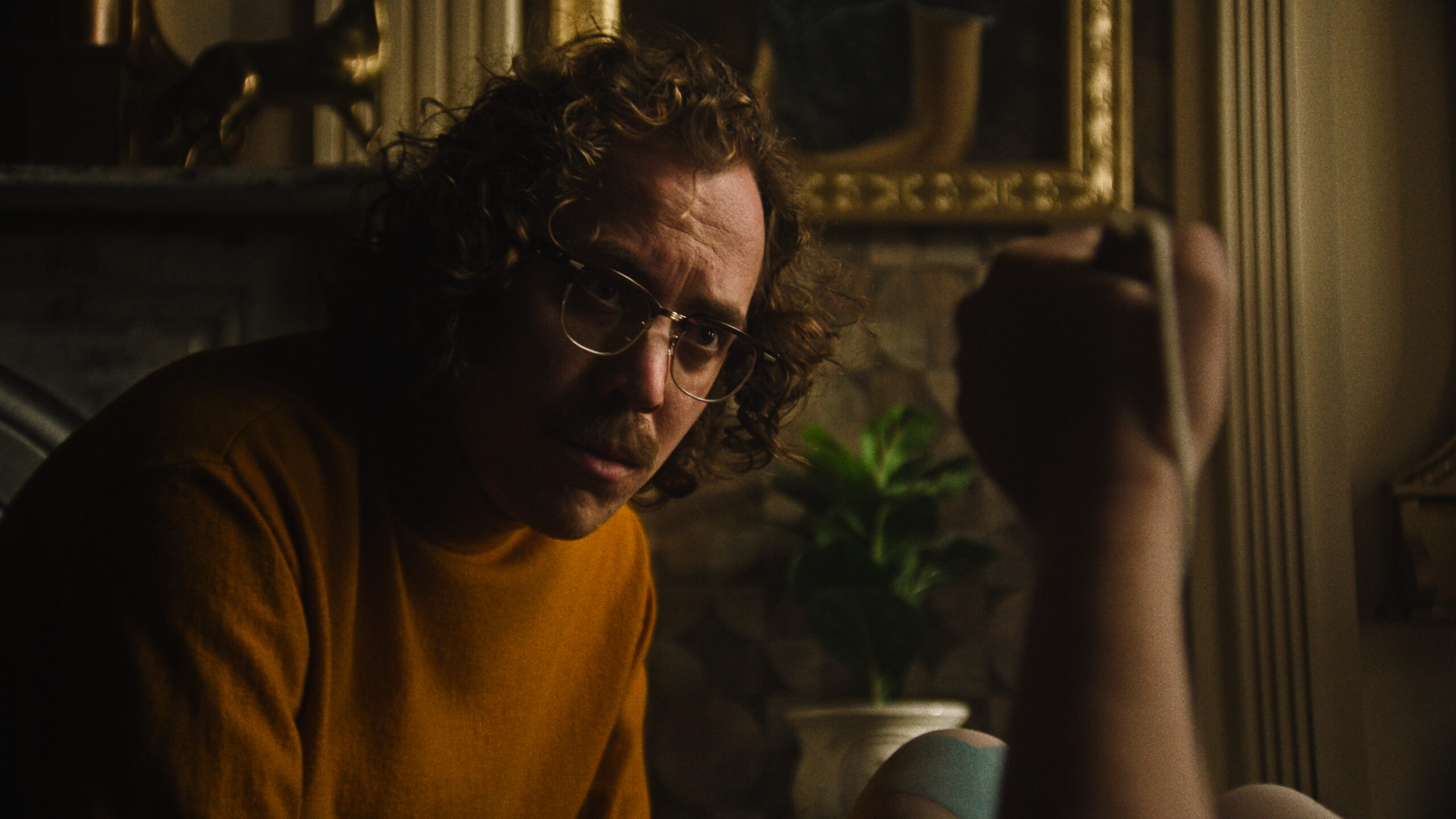
Ben Petrie (HOMER), © 2025 Cat People
Because Glowicki and Petrie are partners in real life, they bring another layer to the portrayal of a marriage under siege. This complicates the standard victim/villain dynamic, suggesting that Homer’s controlling behaviour may be born of a desperate, if twisted, love.
I love Ben. I’ll put him in all my movies. I wrote him a role in the movie that I’m trying to shoot this year – Matt Johnson (director of Nirvanna the Band the Show the Movie)
The script walks a precarious tightrope between horror and comedy, a balance that doesn’t always hold but remains worthwhile in its ambition. It is genuinely funny at times, reinforcing the grotesque, unvarnished mundanity of a long-term relationship.
I mean, there are not too many films where you get characters casually discussing prolapsed anuses. It is a moment that perfectly encapsulates how comfortable we get in relationships, and it serves as a bizarre anchor of normalcy amidst the chaos.
However, there are moments where the film is simply too funny for its own good, and you can feel the tension bleed out of scenes. The film’s sense of escalation starts to compete with its desire to keep undercutting itself.
Grace Glowicki is a brilliant comedic actor—you can see it clearly in Dead Lover—and here she uses her face as a map of confusion and terror. She has that rare ability to turn a facial micro-reaction into a room full of laughter.
Petrie, meanwhile, is one of my favourites at delivering the absolutely deadpan, and others seem to agree. Recently, while interviewing Matt Johnson and Jay McCarrol about their film Nirvanna the Band the Show the Movie (film and interview coming in early February), Matt had this to say about Ben: “I love Ben. I’ll put him in all my movies. I wrote him a role in the movie that I’m trying to shoot this year. I just love him.”
I think I speak for all of us when I say that we can’t wait to see that film.
The Cinematography and Score of Honey Bunch
The visual language here is a study in specific cinematic history. Director of Photography Adam Crosby—who has shot Sims-Fewer and Mancinelli’s previous work—makes a bold technical choice to shoot with vintage 70s Zeiss lenses.
The result, in tandem with the grading from Scott Hannigan and Esat Ozceylan, is a perpetually washed-out aesthetic dominated by muted greys. It’s a decision that feels a little on-the-nose at first, but the diffuse optics introduce a softness that borders on the sickly. The image lacks the sharp, digital crispness of modern horror, creating a texture that mirrors Diana’s cognitive dissonance.
Honey Bunch is a perfect representation of Canadian indie filmmaking: gritty, collaborative, and unafraid to be weird. – Points of Review
There is a perpetual haze hanging over the images, creating a lack of clarity as a literal manifestation of Diana’s interior state.
The camera is also frequently in motion, utilizing crash zooms, and at times the use of long lenses compresses the space between the observer and the subject, forcing us into the uncomfortable role of a voyeur watching a woman who does not know she is being watched.
Sound-wise, the film is aggressive—loud and abrupt. This sonic landscape, scored by Andrea Boccadoro, rejects subtlety and is unafraid to get in your face, and draws heavily on 70s influences, recalling the sometimes melodramatic intensity of Carrie.
Additional credit to Tenille Shockey for the special effects makeup design, transforming Grace in some scenes into something truly remarkable (and respect to Grace for spending hours in the makeup chair for those days).
Love and Control

Grace Glowicki (DIANA), © 2025 Cat People
The film is driven by a simple thematic question: How far are we willing to go for someone we love? And, more uncomfortably: Are we ever really acting selflessly?
Honey Bunch wants mess. It wants you to feel how unstable “love” can become when it is mixed with over-medication, psychiatric control, and the selfish desire to hold onto someone who might be slipping away.
How Can I Watch Honey Bunch?
Honey Bunch is a perfect representation of Canadian indie filmmaking: gritty, collaborative, and unafraid to be weird. It opens in Canadian theatres on January 23, 2026, before streaming on Shudder on February 13, 2026.


