


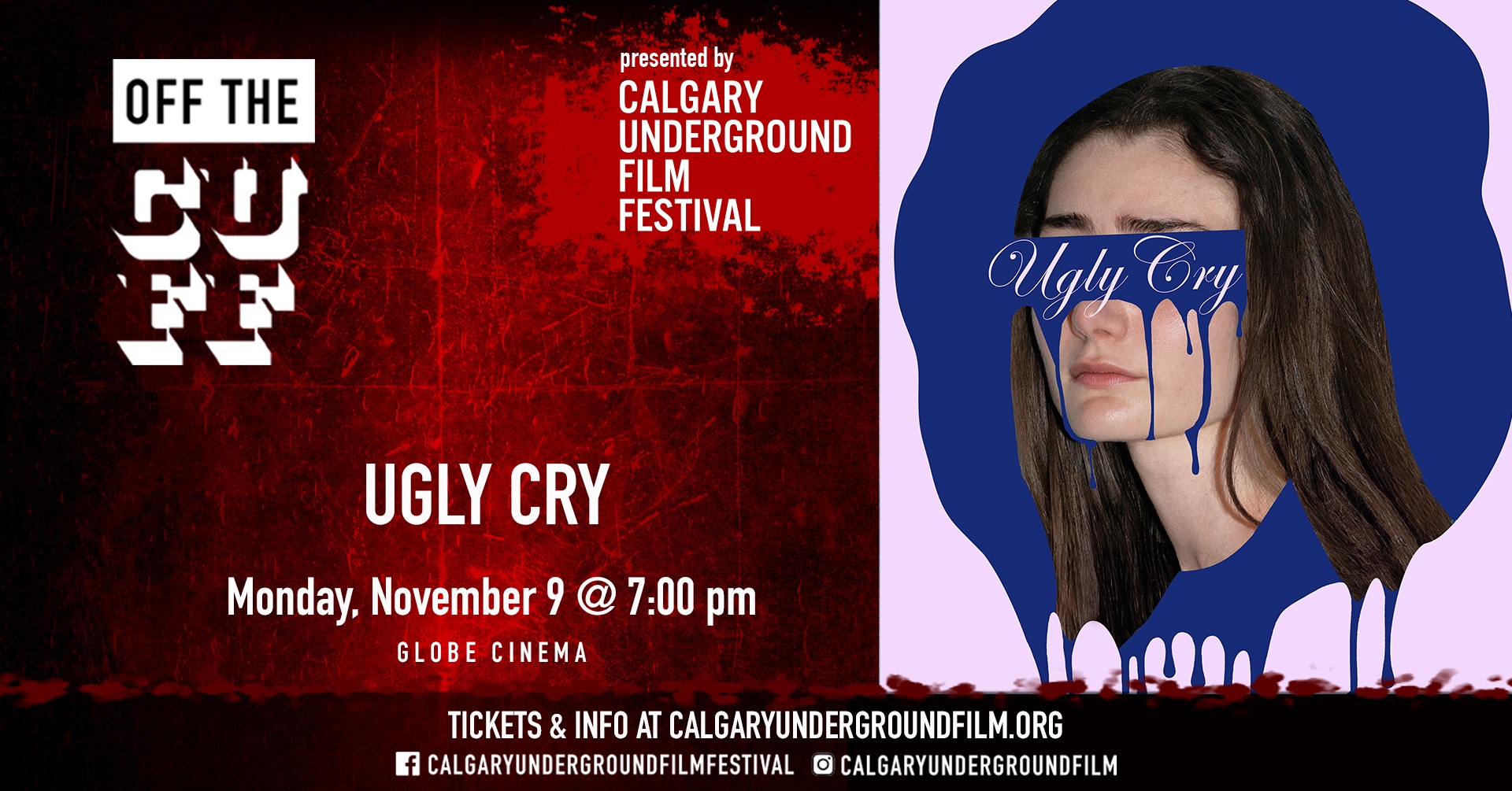
I had Ugly Cry on my list at the 2026 SXSW Film & TV Festival, but as tends to happen when trying to make sense of a festival schedule, there were more films I wanted to see than I could reasonably fit into a day. It was one I missed. Fortunately, with the film now coming to Calgary, I had another chance to catch up with it. Ahead of its Alberta premiere, the Calgary Underground Film Festival arranged for me to interview writer, director, and star Emily Robinson. Ugly Cry screens at Globe Cinema on November 9 at 7 p.m., as part of CUFF’s year-round Off the CUFF series.
Robinson’s feature directorial debut follows Delaney, an actor who learns that she has lost out on a coveted role because the producers didn’t like the way she cried. Delaney’s response is to examine what might be wrong with her appearance, convinced that she can improve her chances by making herself cry more attractively. It is a peculiar professional criticism, but one that exposes a contradiction at the heart of what performers, and actresses in particular, are asked to do. They are expected to be emotionally vulnerable while remaining beautiful, even when the emotion itself is supposed to involve letting go of that kind of control.
The expectations are not distributed equally, either. Early in the film, Delaney’s boyfriend Miles (Aaron Dominguez), himself an actor, makes an offhand remark about being glad he doesn’t have to worry about crying before heading off to shoot a zombie movie. The comment doesn’t need much emphasis to make its point. Men are certainly scrutinized for their appearance, but the demand that female vulnerability remain aesthetically pleasing carries its own particular weight. When I brought up the contradiction in the film’s title, Robinson told me about a former acting teacher who had contacted her after hearing about the project. The teacher knew someone who had reportedly missed out on a job for precisely the same reason as Delaney: an ugly cry.
Robinson had thought carefully about why crying was the right place to begin. Actors sometimes pursue what she called an “Oscar tear,” even though, outside a performance, tears are often something people struggle to hold back. “And so crying is such an interesting thing. But in theory, it is a vulnerable admission of emotion, and it is a moment when your guard, in theory, is down, right?” she said.
I recognized something of myself in Delaney’s response to criticism, even though my work is very different from hers. I can convince myself that I need to be the best at whatever I pursue, then compare myself to others and decide that I’m not doing enough. It’s an impossible standard to satisfy, particularly when every perceived shortcoming becomes another reason to work harder.
Robinson described the film as being about perfectionism and “striving to reach a ‘there’ that doesn’t exist,” with insecurity and competition gradually pushing Delaney further into isolation. When we spoke, I was particularly interested in the relationship between those pressures and the way she understands her own creative life. She has been performing since childhood, but acting is now only one part of what she does.
Emily Robinson: Growing Up in Front of the Camera
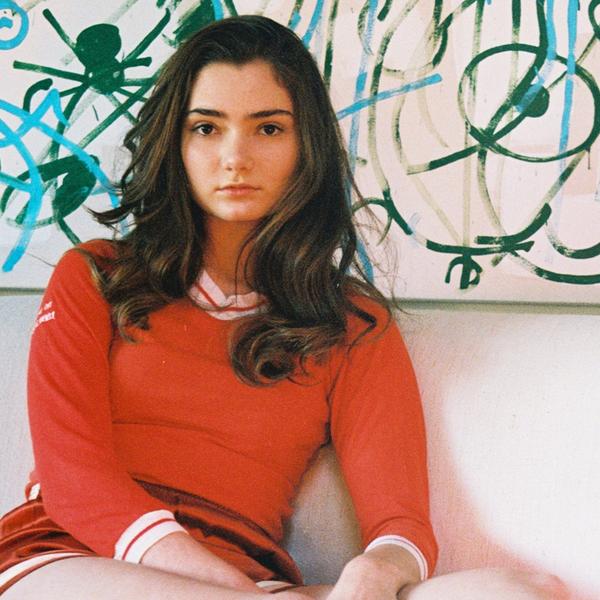
When I asked Robinson whether she could remember a life before acting, she answered succinctly: “Barely.”
She started modelling at around five years old and has worked in entertainment in some capacity ever since. Given how early she entered the industry, I was curious about what had changed in her relationship with acting over that time. Her answer began with an affection for the experience of performing that has remained remarkably consistent.
“I think I will always love acting so much. It is the freest feeling because you have to drop all the overthinking and just be present,” she told me.
I found that description particularly interesting in light of Ugly Cry, because Delaney spends so much of the film doing the opposite. Rather than losing herself in a performance, she becomes consumed with observing and correcting it. Robinson, who describes herself as shy even after a lifetime on screen, said that acting gave her a safe way to take up space as somebody else. In her own work, the opportunity to stop thinking about herself can be a relief. The irony is that the profession built around that freedom can also require an almost exhausting degree of self-assessment.
Robinson made a distinction between acting and the business of being an actor. It isn’t the performance itself that she struggles with, but what she called “the infrastructure around it.” She spoke about the uncertainty of freelance work and how little control an actor has over whether an audition leads anywhere. For someone who describes herself as a Type A overthinker who needs to keep busy, that lack of agency can be particularly difficult.
Writing offers Robinson a way to keep creating without waiting for someone else to give her a role. It has long been part of her acting practice, including the journals she uses to work through characters and ideas. In 2023, she published her first novel, Consumed, and Ugly Cry now adds feature writing and directing to the work she can pursue on her own terms.
With that range of roles in mind, I wanted to know how she identifies herself when somebody asks what she does. The question is a little awkward for anyone whose work doesn’t fit neatly into one category, something I can relate to, but it also felt relevant to a film in which professional failure becomes so difficult to separate from personal failure. Robinson’s answer was that she usually says she’s a writer, though she was quick to explain that it is as much a way of protecting herself as it is a description of her work.
“I say I’m a writer, but I think that’s because it feels less bad than saying you’re an actor or a director,” she said. Identifying as an actor can lead to the immediate question of whether somebody would recognize her from anything, or, in certain Los Angeles circles, the assumption that she must be looking for an opportunity.
Writing does not eliminate that vulnerability entirely, however, as Robinson recalled the discomfort of telling people she was working on a novel before she had a published book to show for it. What is different, though, is how much of herself she feels obliged to explain.
“‘Writer’ feels a little more protected. I can kind of say what I want to say and open up if I feel like actually talking to people,” she said. “So it’s more of a defensive response than how I view myself.”
Ugly Cry: Mirrors, Screens, and a Fractured Self
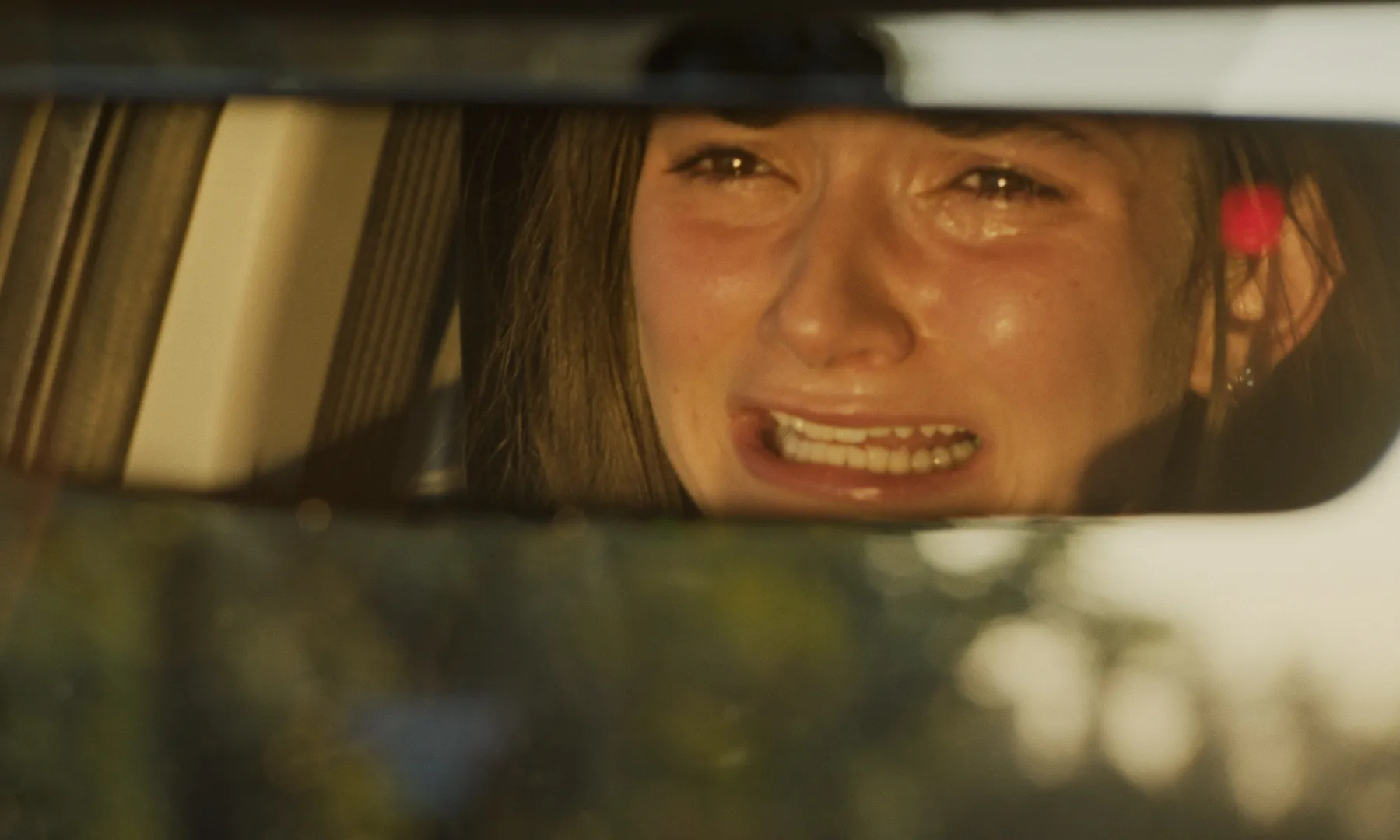
I have always been drawn to the use of reflections in cinema and art, partly because there is something strange about how we become familiar with our own appearance. Most of us know our faces primarily through mirrors, which show a reversed image of the one people around us see. A photograph can be surprisingly uncomfortable simply because it presents a version of ourselves we aren’t accustomed to, even before accounting for the effect of varying lenses and angles. We look at ourselves constantly, yet that familiarity doesn’t necessarily mean we see ourselves clearly.
That interest made the visual language of Ugly Cry one of the first things I wanted to ask Robinson about. Delaney’s image appears in mirrors, on phones, and through other screens throughout the film, often putting a layer of glass or another camera between her and the audience. Those choices become more pronounced as Delaney’s attempt to improve herself grows increasingly desperate. The film repeatedly asks us to watch a woman looking at herself, but each new image seems to offer another reason for her to distrust what she sees.
Robinson explained that she and cinematographer Brody S. Anderson were thinking about degradation as well as reflection. Most of the film was photographed on an ARRI Alexa 35, but some full-screen footage came from an iPhone. The difference in image quality was intentional. “Having that counterpoint and seeing the graininess and seeing how images get distorted felt important to the film because we are seeing so many different layers of performativity of self and degradation of who she is as she conceives herself,” she told me.
Robinson and Anderson pursued that instability through the framing as well. Robinson said the early images generally contain a single mirror or screen, before multiplying into more fragmented compositions as the film becomes increasingly claustrophobic. She and Anderson drew on Black Swan, particularly an image of Natalie Portman that kept returning to their mood boards. “We kept thinking about, ‘Okay, how can we continue to fracture her face?’” Robinson said. That fragmentation extended beyond the cinematography to the set design, allowing Delaney’s increasingly fractured self-perception to find expression in the spaces around her.
The Horror of Having a Body
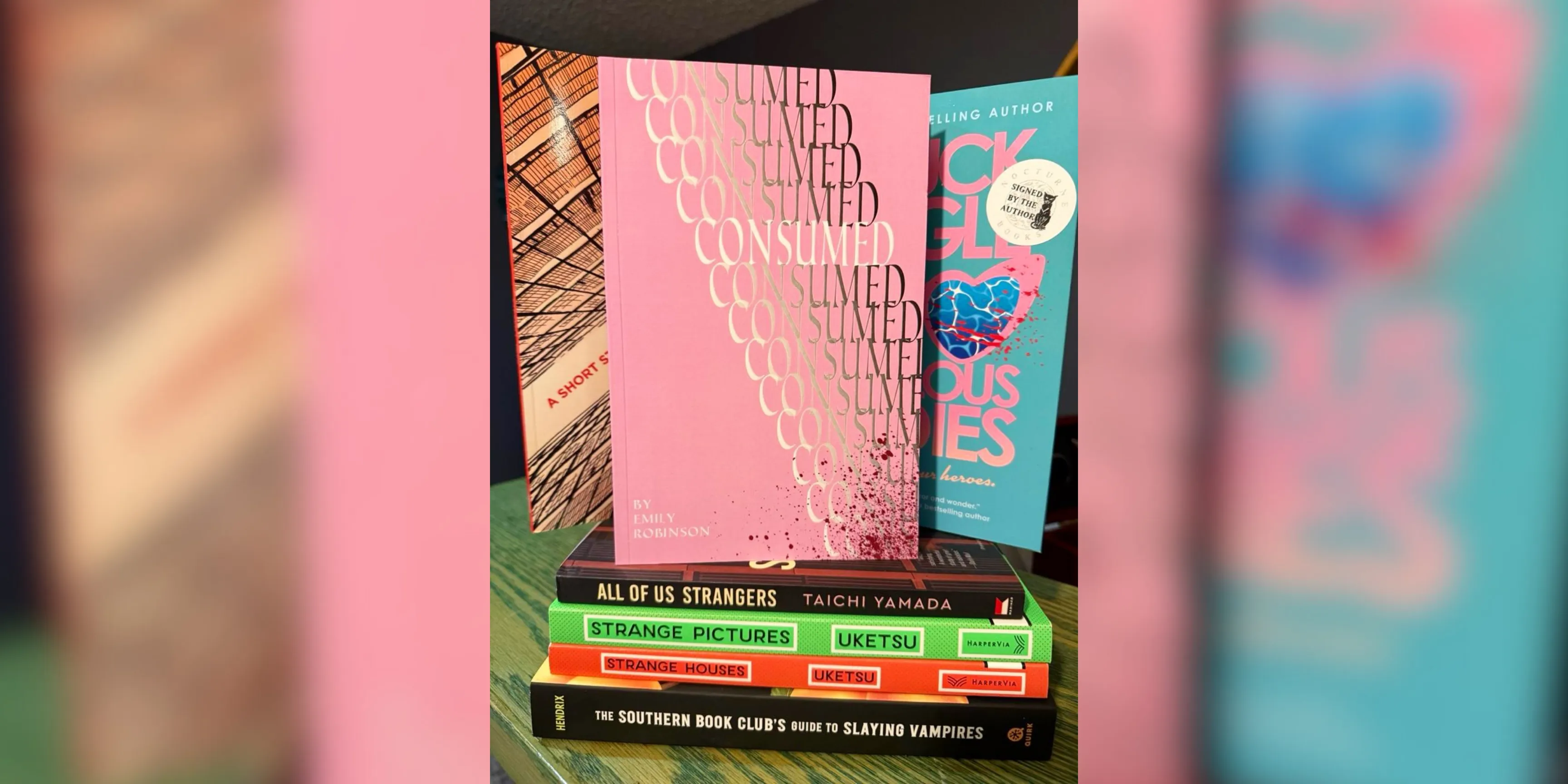
The unease of those images gradually becomes something more physical. For much of its opening stretch, Ugly Cry operates in a recognizable world of auditions, relationships, and the disappointments of a precarious profession. There is humour in Delaney’s situation, although the film never treats her anxieties as trivial. As her attempts to correct herself grow more extreme, that comedy begins to share space with psychological and bodily horror. I asked Robinson whether the change in tone and genre had always been planned, or whether this came later in the writing process.
“That was always in the script,” Robinson said. What remained uncertain was how far to push the horror. “I think the question was, how intensely there? How far do we go?”
Robinson wanted to take the beauty standards and pressures of social media seriously, even as Delaney’s behaviour became increasingly extreme. The challenge was determining how far she could push that behaviour while keeping it connected to something recognizable. “What is real, and what is a few jumps away from reality but could happen?” was how she described the question.
Robinson’s cinematic references weren’t confined to a single genre. She mentioned Sunset Boulevard, Maps to the Stars, Swallow, and the work of David Cronenberg, before explaining that the list was so extensive because they were “straddling genre and straddling tone.”
Shiva Baby came up in conversations about “the stressfulness and the humour,” despite being a very different film. Sick of Myself, meanwhile, became a recurring reference because of how it handled the escalation into more disturbing material. As Robinson explained, “that gets a little bit more gory, but it still did straddle the comedy and the intensity in a way that I really respond to.”
By the edit, that concern had become a question of timing. Working with editor Patrick Lawrence, Robinson recalled repeatedly asking, “Are we giving people permission to laugh early enough?”
Some of the social-media footage was filmed during the edit, while a character who originally appeared as Delaney’s agent was rewritten as her manager, allowing for a more casual and humorous dynamic. Robinson spoke enthusiastically about the freedom to continue reshaping the film throughout production, even when that meant reconsidering decisions made during writing. “I love feeling like you are rediscovering and rewriting the project at each stage,” she said.
She also spoke about body horror as something she seems to have found her way into almost unintentionally. “I don’t know. It feels like being a person is like weird fleshbags, you know? And that feels so natural,” she said, before wondering whether that was concerning, fun, or both.
That brought me back to a line from Robinson’s official director’s statement for Ugly Cry: “It’s not body horror, but it is a film about the horror of having a body.” Having just discussed her attraction to the genre, I wanted her to expand more on this idea.
Robinson connected the statement to her experience growing up in the film industry, and to how that shaped her understanding of gender and her own body. She described having to work through a kind of self-objectification, then recalled the disembodiment she experienced during the pandemic, when so much of life took place through films, phone calls, and Zoom. Those experiences informed Delaney’s dissociation and the increasingly physical ways she tries to reconcile her discomfort with herself.
“Existing in flesh and being on this world is the thing that allows us to live, and also that we are stuck in mortal form,” Robinson explained.
What is Next for Emily Robinson and Ugly Cry?
Ugly Cry is expected to receive a limited North American theatrical release this winter from Obscured Releasing. Emily Robinson is also developing a film adaptation of her 2023 novel, Consumed, which she described as “more intensely body horror.”
For Calgary audiences, Ugly Cry will screen at Globe Cinema on Monday, November 9, at 7 p.m., as part of the Calgary Underground Film Festival’s Off the CUFF series.
Ugly Cry (2026): Cast and Crew
Director and Writer: Emily Robinson
Cast: Emily Robinson (Delaney), Ryan Simpkins (Maya), Aaron Dominguez (Miles), Robin Tunney (Valerie)
Producers: Sophia Sabella, Pablo Feldman, Jolene Mendes, Rhianon Jones, Tristan Scott-Behrends, Emily Robinson
Cinematography: Brody S. Anderson
Editing: Patrick Lawrence
Production Design: Annie Becker
Original Music: Sóley Stefánsdóttir


