



Written and directed by Sandra Wollner, Everytime doesn’t take much time to move into a devastatingly emotional sequence in its first act, forcing the characters to settle into its aftermath. That is difficult territory for any movie. When something hits that hard early, there is always the question of how you sustain that emotionality over the remaining runtime. Wollner largely avoids that problem by moving in the opposite direction. The film becomes quieter, following three people as they try to continue with relatively ordinary lives after something has permanently changed between them.
For a while, it really works. Then, somewhere in the second act, I started wondering whether that was all Everytime would be. I understood the portrait of grief. I understood that everyone was processing it differently. I appreciated how carefully Wollner was approaching all of this, but I was checking out a little.
Then the third act came, and it brought me back full force, times a thousand.
It is one of my favourite third acts in a film in quite some time, and it immediately made me want to watch Everytime again. Part of that comes from where Wollner ultimately takes the film, but it also comes from realizing how much she and cinematographer Gregory Oke had been quietly setting up during those much more grounded first two acts.
Wollner wanted roughly the first hour to feel extremely grounded, with occasional moments suggesting that something was “shimmering beneath” the realism.
Knowing where Everytime ultimately goes makes those small moments incredibly meaningful.
Everytime screened at the 2026 Toronto International Film Festival following its Cannes premiere in Un Certain Regard. Canadian distribution is being handled by Films We Like.
What is Everytime About?
Everytime follows Ella (Birgit Minichmayr), her younger daughter Melli (Lotte Shirin Keiling), and Lux (Tristan Lopez), the boyfriend of Ella’s older daughter Jessie (Carla Hüttermann). After a tragedy brings them together, the three eventually travel to Tenerife for a family holiday that never happened.
This trip ultimately serves as a point where “past and present quietly start to overlap,” which is probably about as much as anyone should know before seeing the film.
Before getting there, Wollner spends a long time with ordinary life. There is homework, shopping, eating, travelling around Berlin, and trying to get through uncomfortable conversations. Grief exists in all of it, but the movie rarely pauses so the characters can explain what they are feeling.
That approach goes back to the first image Wollner had while writing. She imagined Ella lying on the couch and hearing or remembering the ordinary sounds Jessie would have made around the house: footsteps, someone checking a phone, talking, flushing the toilet, or playing some piano. Wollner said the characters themselves also developed from people and “ghosts” she had carried with her from her own life.
Those banal sounds become important because Jessie remains present in the film long after she is gone.
Gregory Oke, Aftersun, and the Shape of Absence
The Aftersun comparisons are difficult to avoid.
Gregory Oke shot both films, and there is also some clear overlap in their interests: memory, grief, family, loss, and the subjectivity of memory.
Everytime is not quite as strong as Aftersun, but that says more about the absolute brilliance of Charlotte Wells’ directorial debut than it does about this film.
Some of the visual overlap is interesting, though.
Oke and Wollner regularly use doorways, walls, and different planes within the frame to separate people. It reminded me of the hotel room in Aftersun, where father and daughter occupied different spaces within the same room, neatly divided. In Everytime, those divisions frequently become a way of showing absence as much as separation.
There is a similar sense of distance in the way the camera watches these characters. The film opens looking through trees, and Oke frequently uses long lenses and objects within the environment to partially obstruct our view. It can feel voyeuristic, like we are watching family moments that are not really ours to see. At other times, the camera follows the characters much more smoothly, and that perspective starts to feel less attached to a single observer and more aligned with an ethereal presence moving through both time and space.
The film also just looks beautiful. Shooting on film gives the images plenty of visible grain, with some especially nice halation around the highlights. There is a moment with Ella where that effect is particularly gorgeous.
There is one point, however, where the similarities to Aftersun become too much for me.
Everytime includes a dance-club sequence that feels extremely close to one of the most recognizable sequences in Wells’ film. Given that Oke shot both movies, the resemblance is hard to ignore. I wish the scene were not there, mostly because the comparison already exists naturally, and Everytime has enough of its own visual ideas that it does not need something this close to its predecessor.
My favourite shot in Everytime actually comes during an elevator sequence with Melli. I imagine a lot of people will come away talking about the rooftop or some of the later images around the ocean and sun, but the elevator was the moment that completely brought me back into the film.
It uses reflection to shift our perspective of Melli and the space around her. That technique is not unprecedented, but the timing of it is beyond beautiful.
Keeping Jessie Present: Sound, Space, and Digital Ghosts

Jessie remains present in Everytime in many small ways.
Sometimes that is through sound. A melody she played early in the film appears again in the background. At other points, we hear her footsteps. Other characters find her through photographs, recordings, and the places she used to occupy.
Melli’s version of that is particularly interesting because it happens through a video game.
And, as Wollner was quick to correct during the Q&A following the final screening at TIFF, it is not Minecraft. It is Vintage Story.
Wollner described the game as a contemporary form of memorial. We are used to the idea of remembering people through photographs, diaries, or old videos. Here, Melli can actually walk through a digital world her sister created.
This idea updates the film’s concept of memory without making a huge point about technology, which might be distracting. Jessie left something behind, and Melli can move around inside it. It is simply another form a memory can take.
Ultimately, the first two acts are full of places where the characters can still encounter pieces of Jessie even though she is not physically there. The third act starts playing with how far that idea can go.
There are portions of the middle that could be tighter. At the same time, the grounded quality of that section makes the eventual shift much more effective.
Wollner said she wanted those early stretches to feel very down to earth, while including a few moments that suggested there was something else underneath them.
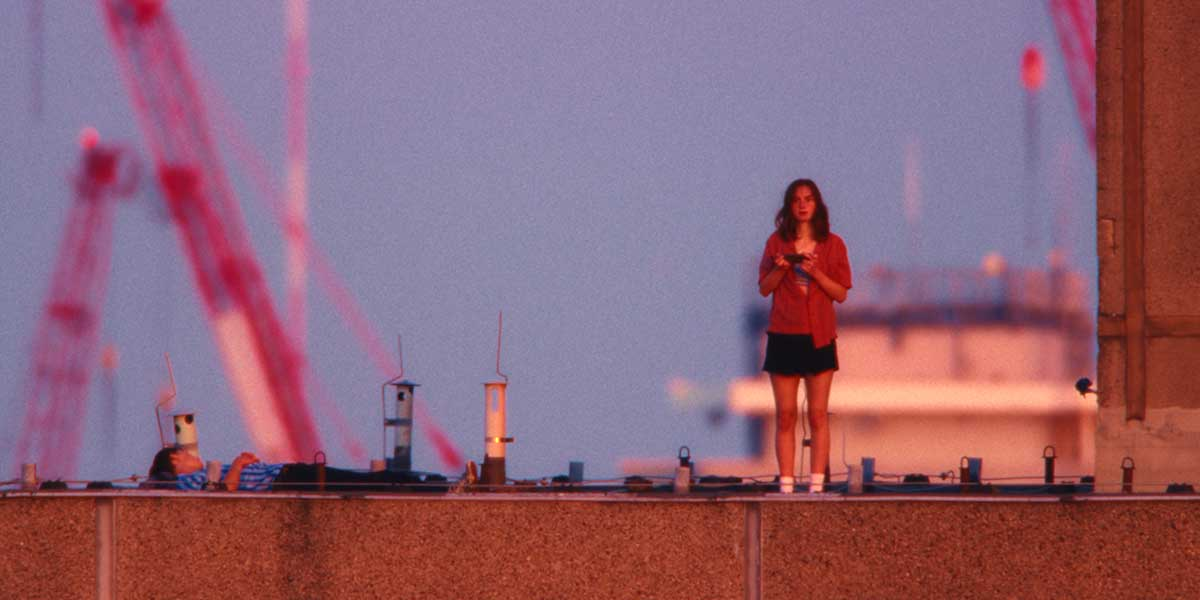
Without going into spoiler territory, the rooftop sequence is probably going to be one of the images most people remember from the film. Oke uses an incredibly long zoom during this early moment, and there is something slightly strange about the perspective even before the film openly moves into more explicit surrealism.
When Memory Becomes Physical

Water is another way that Wollner bridges the gap between the real and the unreal.
It shows up in Berlin, it shows up on holiday, and it shows up as inconspicuously as a water bottle slowly leaking onto a shirt. In its essence, water connects one time or place to another on a sensory level, and can allow one to travel through memory.
Setting the holiday location, then, needed to be near the ocean, and Wollner ultimately settled on Tenerife. The choice of location was partly practical, but Wollner said that Punta del Hidalgo in the north of the island had a quality that felt almost outside of time. An apartment building from the late 1960s and the nearby lighthouse both had something strange about them, enough that she decided to shoot there even when it was less convenient for the story’s practical geography.
That setting works extremely well once the film starts moving away from the realism of Berlin.
And this is the location where the lines that neatly demarcate our reality become increasingly blurred.
I am naturally drawn to surrealist films, particularly when the surrealism comes from something emotionally recognizable rather than existing only for abstraction. Counterintuitively, that can sometimes make a film feel more grounded. Real life is not always logical, and grief certainly is not. You can know that someone is gone while still hearing them in a room or momentarily expecting them to walk through a door.
Everytime takes that feeling much further than I expected.
Wollner said that while writing, she would occasionally follow a sentence even before she fully understood why it belonged in the film. One of those sentences was, “The sun did not set.” She compared the process to following a line in a song that may not initially make literal sense but has some kind of internal logic.
That eventually led her toward one of the film’s central ideas: what would happen if you could remember somebody so vividly that you could enter that memory, hold them, and perhaps try to bring them back with you?
That is where Everytime really clicked for me.
The photographs, sounds, empty rooms, recordings, and digital spaces in the earlier parts of the film all become different ways these characters continue to encounter someone who is gone. The final act takes the same impulse and brings us somewhere that I would find difficult to articulate, even if I wasn’t trying to avoid spoilers.
Is Everytime Worth a Watch?
Yes, absolutely.
My experience with Everytime was uneven, but that actually makes me more interested in revisiting it, particularly after knowing where Everytime eventually goes.
What begins as a film about three people trying to continue after a death gradually becomes a film about how memories remain attached to places, sounds, photographs, and even digital spaces. Eventually, Wollner takes the impossible wish underneath all of that remembering seriously: if you could somehow get back to the person you lost, even for a moment, what would you do once you found them?
Everytime screened at the 2026 Toronto International Film Festival following its Cannes premiere in Un Certain Regard. Canadian distribution is being handled by Films We Like.


