



The Sun Never Sets Review | Joe Swanberg Returns With One of His Most Complete Films Yet
There is something fitting about seeing Joe Swanberg back at SXSW with a full-length feature. For a certain generation of American independent film, Swanberg was one of the defining architects of a loose, intimate, improvisation-driven style that would eventually get folded into the ever-clumsy label of mumblecore. He built a career out of naturalistic dialogue, emotional messiness, and the uneasy rhythms of ordinary people trying to figure out what they want from each other. He also worked closely in those early years with filmmakers and performers like Greta Gerwig, who became part of that same broader scene.
That is part of what made The Sun Never Sets feel so satisfying to me. It is not just that Swanberg is back with a feature after a long stretch away from them. It is that he is back with one of his strongest and most cohesive films ever.
I caught the project at the 2026 SXSW Film & TV Festival, seated directly behind Swanberg, which is always a slightly surreal but very fun way to experience a movie like this. And what struck me most is how complete it feels. Swanberg’s films have often thrived on looseness, but this one never feels shapeless. It has the lived-in naturalism you want from him, but it also feels mature, controlled, and more broadly accessible than some of his earlier work.
What is The Sun Never Sets About?
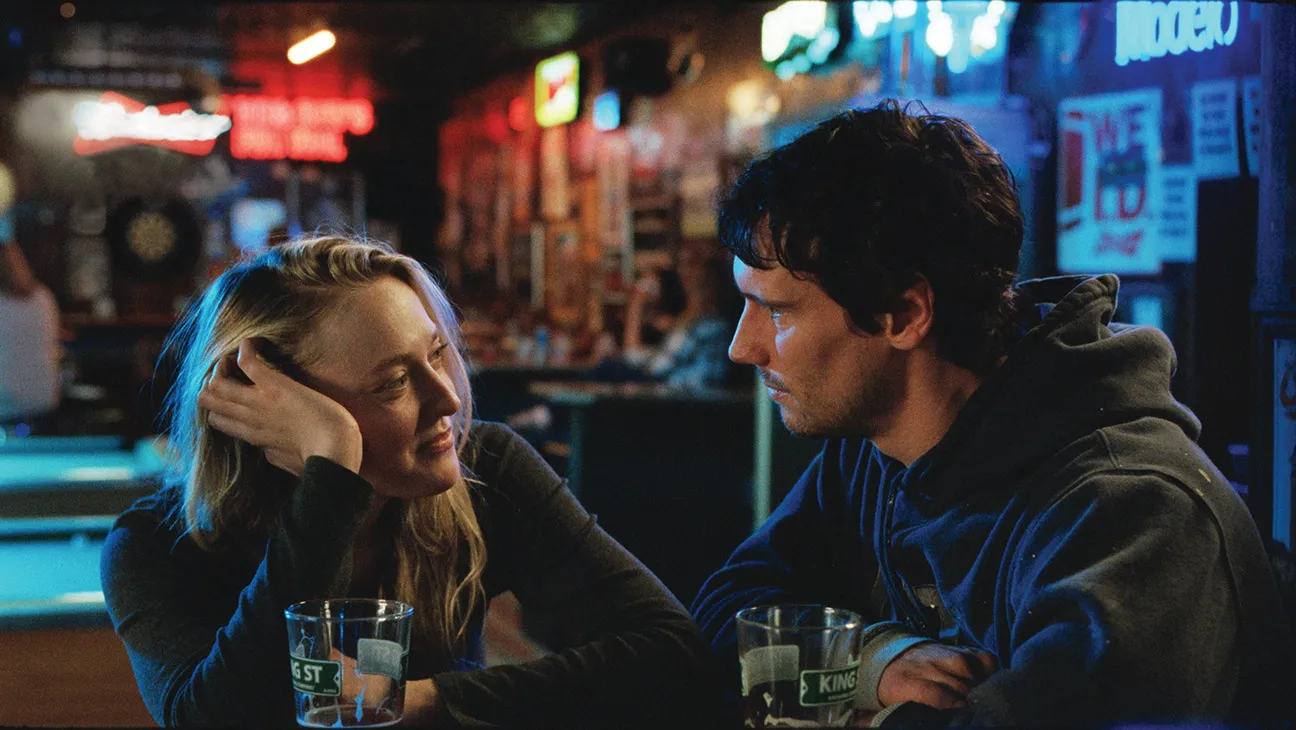
The official premise is simple: Wendy’s (Dakota Fanning) life is thrown into chaos when her boyfriend Jack (Jake Johnson), who is older, divorced, and already has children, suggests they take space to evaluate their relationship. During that break, she runs into her ex, Chuck (Cory Michael Smith), and the resulting triangle forces all three characters into a volatile, emotionally messy recalibration of what they actually want. That is the basic structure, and on paper, it sounds incredibly familiar to many films we have seen before.
That familiarity is part of what makes the film so interesting. On the surface, this could almost be a Hallmark setup: a woman caught between the stability of one man and the disruptive pull of another, torn between comfort, memory, adventure, and the possibility that neither option is really the right one. We have all seen versions of that story before. What makes The Sun Never Sets work is the margin of nuance. It is a very good case study in how fine the line can be between cliché and insight. Change the tone slightly, make the writing a little more declarative, and this becomes something far more conventional.
That sensibility is deeply tied to Swanberg’s place in the broader mumblecore tradition. He has long been associated with a lo-fi, improvisational style, and he has described much of his work as being built from outlines rather than rigid dialogue-heavy scripts. That method shows up here again. The characters feel like they are discovering what they think in real time rather than simply delivering tidy thematic points. That looseness matters because these people are not operating from clarity. They are clouded by desire, jealousy, fear, habit, and the simple fact that human beings are often irrational when they are desperately trying to figure out what kind of life they want.
That is why the film never slides into rom-com neatness. It stays just messy enough. The decisions do not always feel logical, but they feel believable.
The Cast of The Sun Never Sets

This is, above all else, a performance film. Swanberg’s approach has always depended on giving actors room to breathe, and that room is crucial here. The dialogue has that slightly awkward, naturalistic give-and-take that comes from performers sounding like they are actually thinking instead of simply hitting pre-determined marks.
Dakota Fanning is the centre of it all, and the film absolutely belongs to her. Wendy could have been a frustrating character in another movie. She is indecisive, emotionally pulled in different directions, and not always easy to read. But Fanning gives her such interiority that the uncertainty becomes the point rather than a flaw. You believe her confusion. You believe that she is making choices that may not be wise, but make complete sense in the moment she is living through. There is a real depth to the performance, and she is the main reason the film’s emotional ambiguity feels so compelling.
Jake Johnson is also strong, and in a very different register. Swanberg has worked with Johnson many times before, and that familiarity is evident. There is an ease to Johnson’s work here that feels built on that long creative history. He is the funniest presence in the film, but it is a very specific kind of comedy: the comedy of a middle-aged man trying to appear stable while panicking about whether his life is past the point of no return. He is funny because he is recognizably human and because his self-awareness is always arriving about five seconds too late.
Cory Michael Smith gives the film its most obvious disruptive charge. Chuck is the kind of character who could very easily become just a type: the attractive, unstable ex who exists only to complicate someone else’s life. Smith gives him enough volatility and vulnerability that he never feels that thin. He understands the toxicity of the character, but he also understands that Chuck is not simply “the bad option.” He is an embodiment of something Wendy still wants, or thinks she wants, and the film needs that tension to remain alive.
Brandon Daley also steals the hearts of everyone in the audience as the tall, awkward, goofball friend who has been in love with Wendy since day one, but has never been able to quite find the words to express himself. His performance earned the empathy of everyone in the theatre, and it was great to see him on screen again, after his project $POSITIONS ended up being one of my favourite of SXSW last year.
Is The Sun Never Sets Worth a Watch?
Absolutely, especially if you have any affection for Swanberg’s earlier work.
His films generally are not about formal reinvention or grand conceptual architecture. They are about the textures of ordinary life, the contradictions inside relationships, the way people speak around what they mean before finally admitting it to themselves. The Sun Never Sets works because it does those things with unusual control. It feels like one of Swanberg’s most complete films, one where the looseness of his process and the maturity of his filmmaking are finally in especially strong alignment.
It also helps that the film looks beautiful. The Alaska setting gives the story a scale and visual identity that elevates the material without betraying Swanberg’s sensibility. Eon Mora, as the cinematographer, uses 35mm film to carry exactly the kind of textured imperfection that suits this world: a little ragged, a little messy, but still full of beauty.
I also think this is one of the more accessible entry points into Swanberg’s work. If you already know you hate that mumblecore frequency, the film may still not win you over. It is still built around conversation, ambiguity, and people making imperfect choices. But if you have sat on the fence with Swanberg’s earlier work, this is one that might change your mind, and at this point in the festival, it is sitting near the top of my SXSW list.
The Sun Never Sets had its world premiere at the 2026 SXSW Film & TV Festival on March 13.


