


Nicole Bazuin on Modern Whore: Offering a New Archetype of Sex Work
What is Modern Whore About?
Modern Whore is an 80-minute hybrid documentary directed by Nicole Bazuin, which is the latest in a lengthy collaborative relationship with Andrea Werhun, including Modern Whore: A Memoir and two short films. This feature-length documentary stars Werhun as she reclaims her story through stylized reenactments, animation, and first-person interviews – ultimately reframing the tired “victim or villain” portrayals of sex work, and I had the chance to chat with Bazuin in the lead-up to its Alberta premiere at the Calgary Underground Film Festival.
The Collaboration of Nicole Bazuin and Andrea Werhun
As mentioned, Nicole Bazuin and Andrea Werhun have built a years-long creative partnership spanning two short films and now a feature-length hybrid documentary, alongside Modern Whore: A Memoir, now with a newer, much-expanded version. That kind of collaborative continuity is rare, and it’s evident that the two have evolved together as artists, so I wanted to ask Nicole how this friendship–collaboration has shifted over time and what makes it so special.
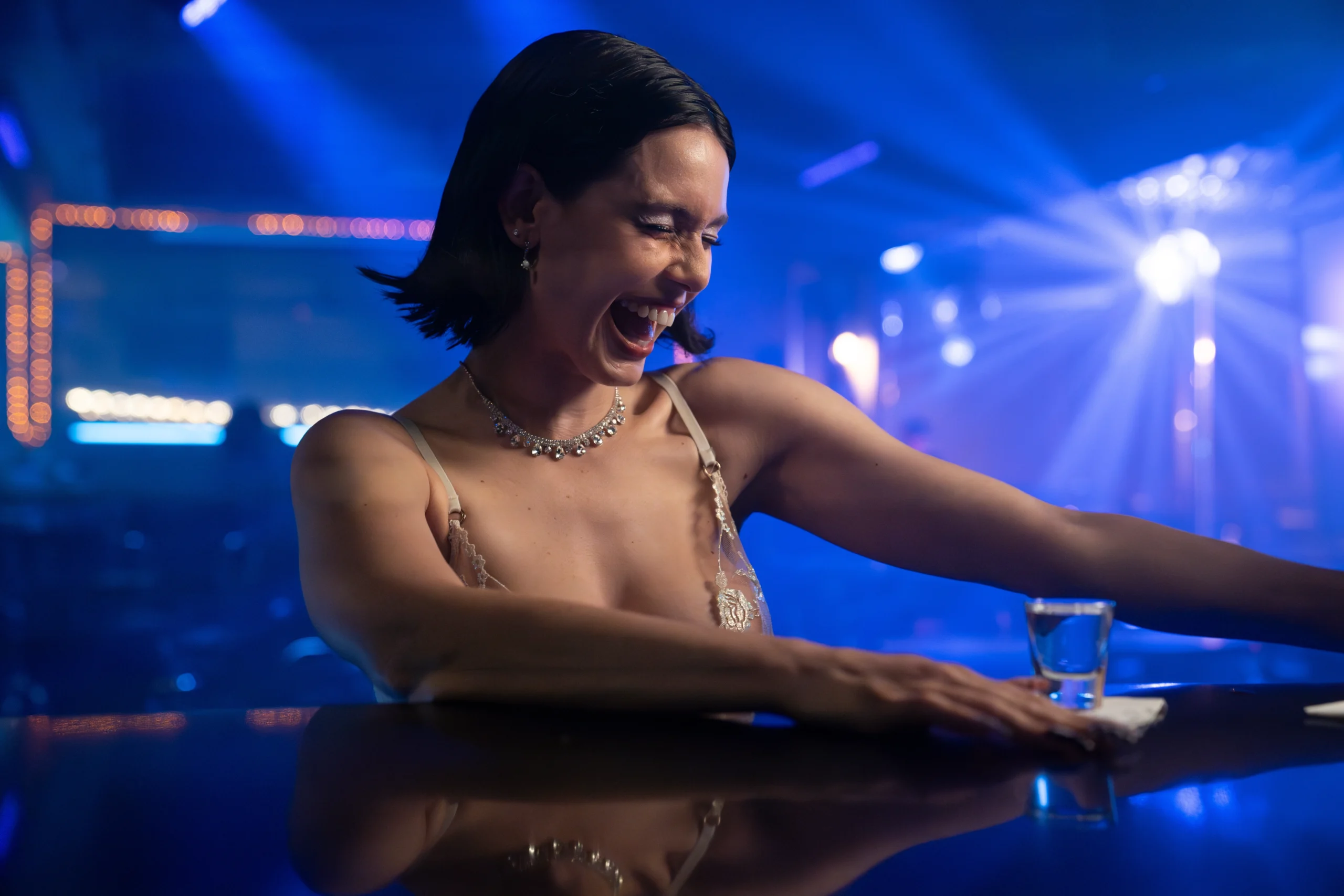
You have known Andrea Werhun for years now, and you’ve worked together on multiple projects. What has that relationship and collaboration been like?
Andrea and I originally met on the set of a music video that I was directing. I was doing this 1960s-style music video, which shows you my tastes have not necessarily changed too much over the years, because I still love that. I wanted go-go dancers for it, and Andrea was recommended to me through friends. She showed up to the set, and I introduced myself and I said, “I’m the director and I will also be go-go dancing with you”, because the other go-go dancer didn’t show up. You do whatever it takes to get it to happen. So the first day we ever met was us go-go dancing in this video and having fun together. It set the tone for our relationship in an interesting way because we were starting on this page that was about making something together and being creative.
From day one, I got to see what a charismatic talent she is in front of the camera. Over time, we developed this “creative crush” on each other when we got to know a bit more about what we like to make. I got to read some of her writing, and she got to see some of my paintings and other work that I was doing. So it just evolved — our friendship and our creative collaboration were evolving at the same time.
To a degree, it’s something you take for granted and roll with in a way — you’re just like, “this is fun”. But especially now at this stage, I’m realizing how rare a connection like that actually is. It makes me all the more grateful. It’s been really fun to do a book together that’s become what it’s become, this 300-page expanded version we did with Penguin Random House. And then to do a full-length feature film as well. It feels like our friendship and our collaboration are on a whole other scale.
Mixing Media in Modern Whore
One thread that runs through all their work is a pull toward multimedia: photo-driven pages on the printed side and, on screen, a blend of animation, stylised staging, and documentary language. In this feature, animation, hybrid reenactments, and non-fiction interweave; in the book, photographs and visual motifs echo Nicole’s background in photography. Nothing they’ve made together slots neatly into a single category, so I was curious what draws Nicole down that path.
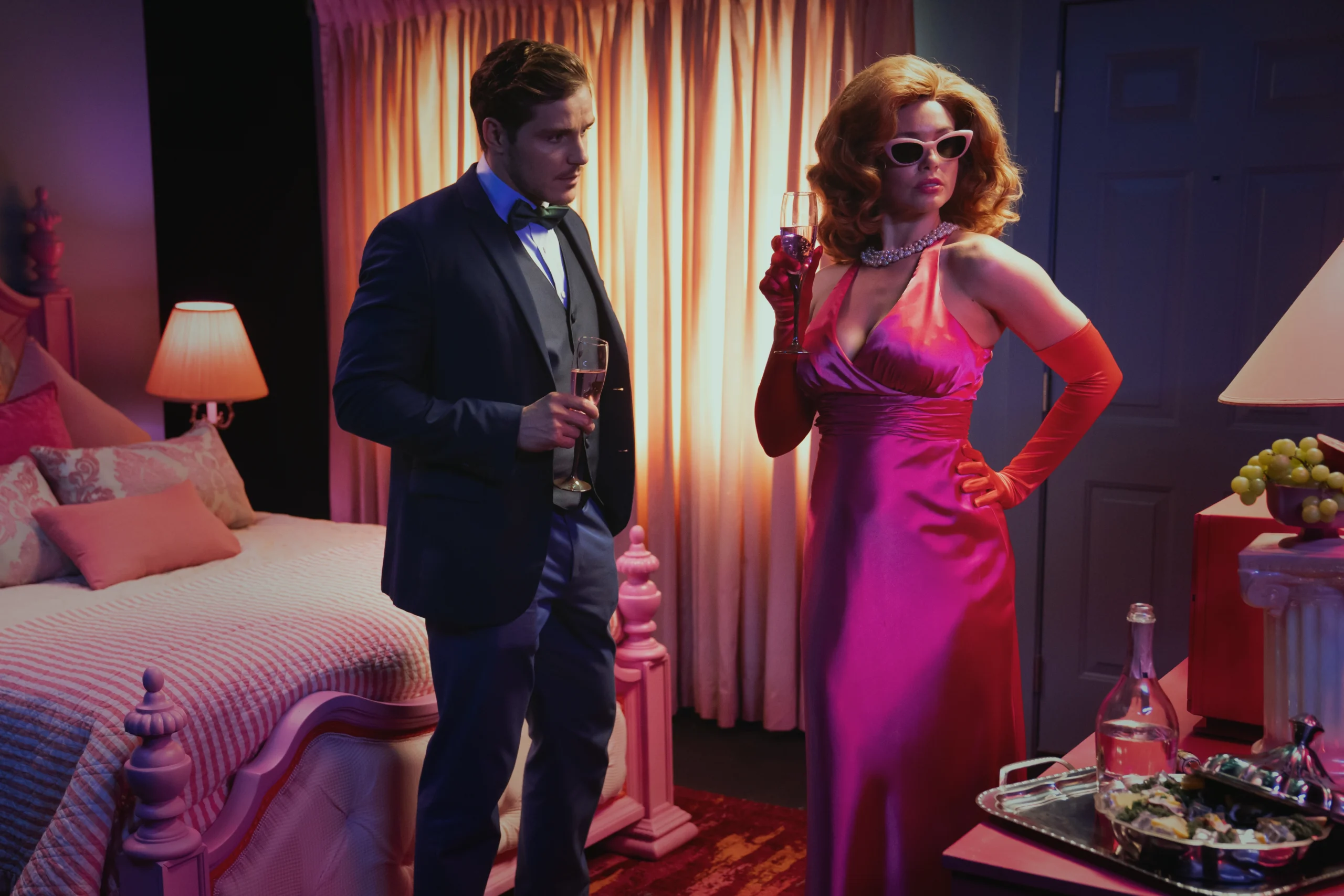
Within this feature, you love to use different kinds media to tell the story. And that was the same with the memoir — this mixing of mediums. What is it that draws the two of you to this style?
I love that you highlighted that in both the Modern Whore book and the cinematic collaborations that exist. Both Andrea and I are shapeshifting artists in a way. We have a lot of different interests, and it just so happens that the things we’re interested in as these multi-hyphenate artists complement each other — she’s a performer and a writer, and I’m a visual artist and a director. When you get two people who have this diversity of interests and different mediums we’re into, it encourages this very multimedia approach. It would be hard for either of us to be confined to just one way to express ourselves.
There’s a multi-dimensional aspect to the story that Andrea’s telling. For one, she has so many sides of her personality, which are fun to explore. Her identity might change in different contexts in the story — who is she with her loved ones, versus her friends, versus with clients? These are different facets of her. It’s also a very multifaceted subject matter. We had so many discussions about wanting to show the funny sides, the joyful sides, but also not shying away from the darker, more challenging aspects of her experience and of the subject matter that we take seriously. That in itself is quite complex — it runs the gamut.
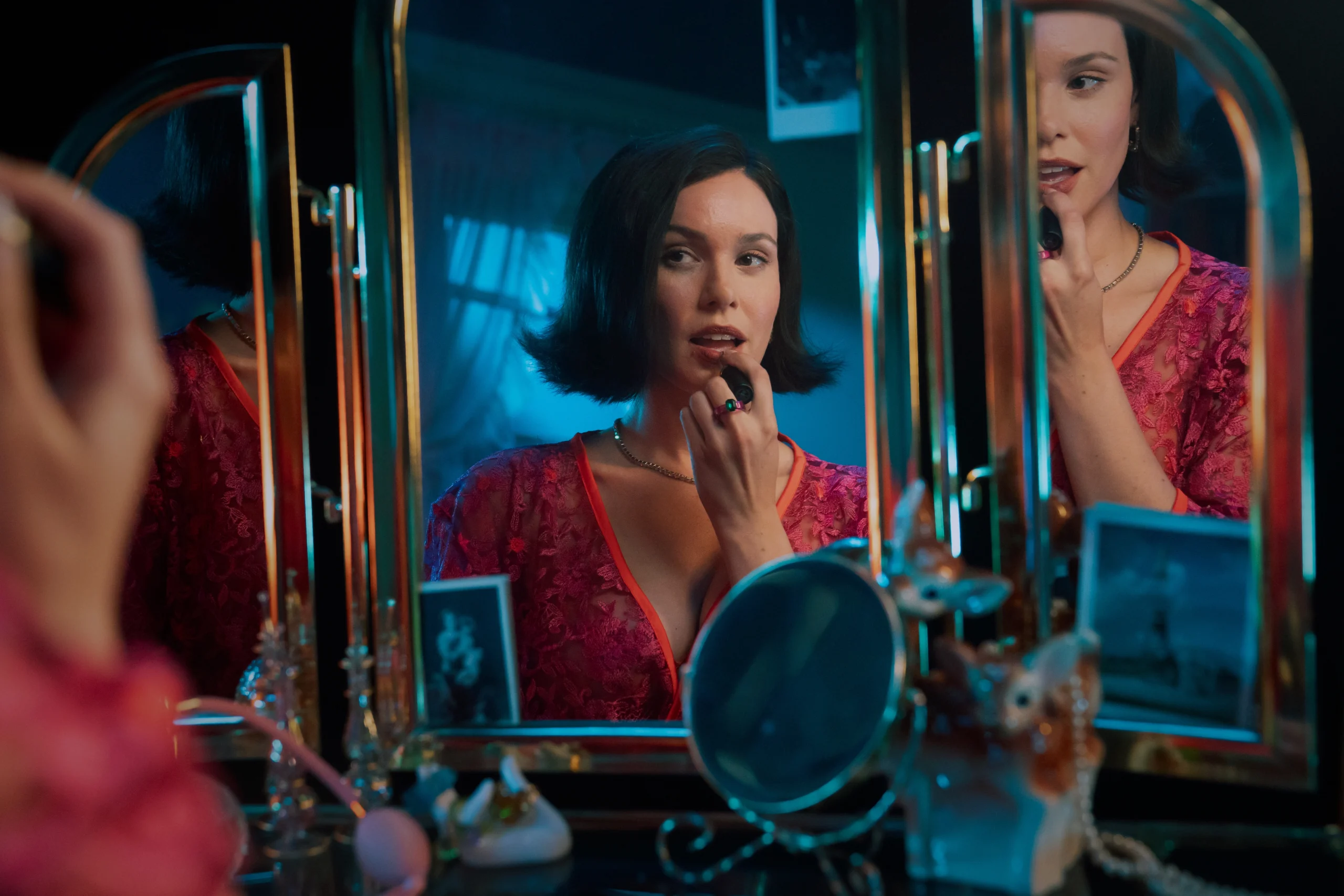
I wanted it to feel like a colourful stage show where the lights are a palette unto themselves – Nicole Bazuin on the visual language of Modern Whore
So, with all those shades and colours to the story, it only makes sense that there are a multitude of different techniques we might use to get those points across. That’s the freedom of a more hybrid storytelling format: it can feel like we don’t have to be confined in how this story is told. Our projects have never fit into a tidy, formal box. The book certainly doesn’t — it has tons of illustrations — and even the way she’s writing shifts stylistically throughout. So it only makes sense for the movie to be this unconventional documentary.
Production Design and Colour in Modern Whore
Another signature is colour — in costuming, production design, lighting, and animation — with neon accents that become focal points. I couldn’t help seeing connections to another great film exploring sex work, Fucktoys (check out Annapurna Sriram’s pitch deck for the film here). Given how pronounced the palette is in Modern Whore, I wanted to know what led to those choices.
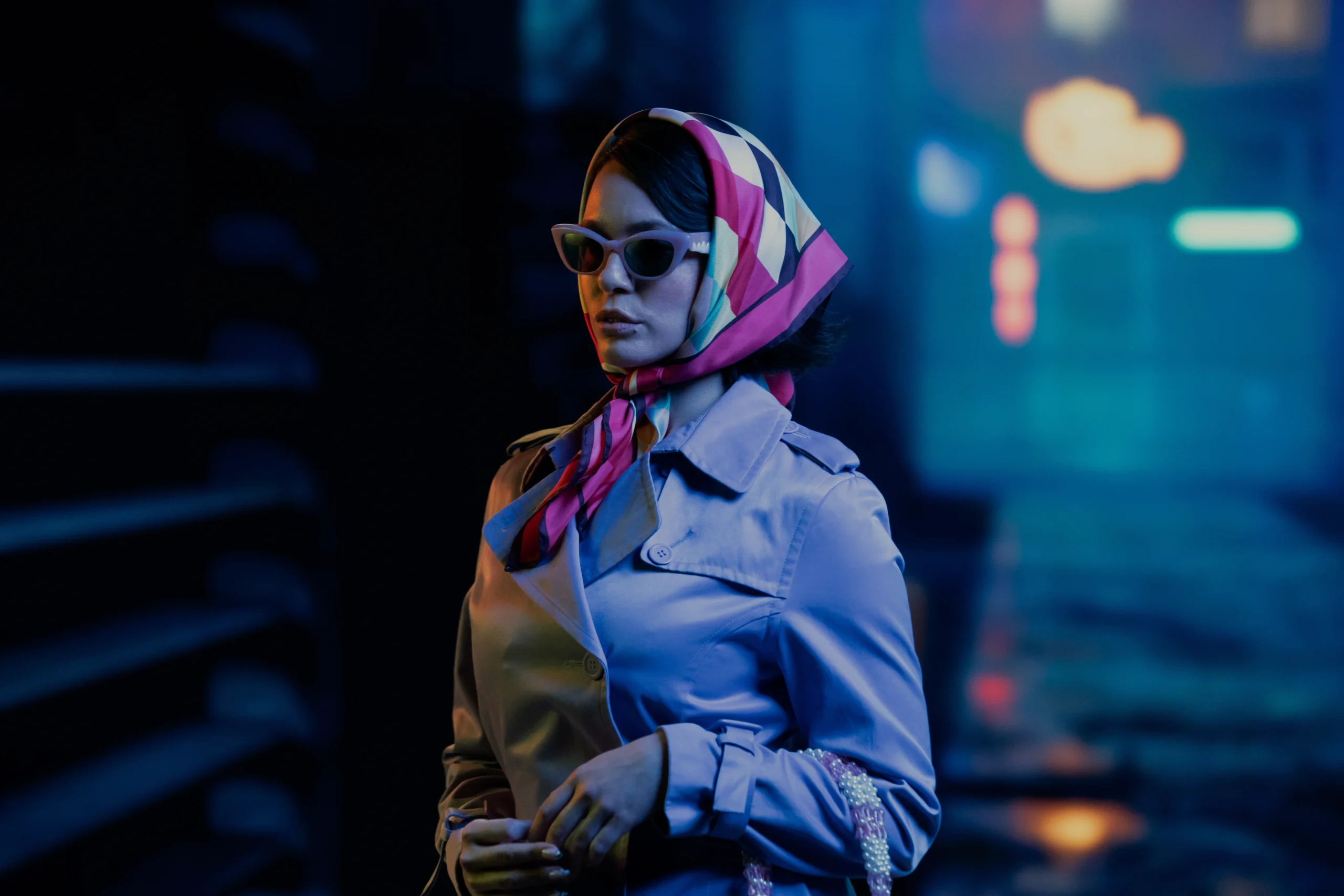
I love that you used the phrase “all these different shades and colours,” because colour is definitely something that, as a viewer, we’re drawn to in this movie. You have bright purples, greens, and all sorts of neon. What led you to this visual landing spot?
For starters, it’s the nature of the filmmaker. I love colour. So we’re going to start there: I love a Technicolour palette to work in. Pair that with the fact that I’m working with cinematographer Nina Djacic, who is also obsessed with colour, and my production designer, Chareese Steinhoff, who is absolutely extraordinary with colour choices and combinations. I’ve tried to pull together collaborators who all love to express a story through the use of colour.
The film oscillates between more extreme, over-the-top moments and something quieter – Nicole Bazuin on pace and tone in Modern Whore
With the film itself, it is very expressionistic; there are many strong emotions and experiences, and the whole notion is to put the audience in Andrea’s shoes. It’s not trying to be objective; it’s very subjective — how does she feel, what are her insights? As the performer and storyteller, she’s leading us through her world. We literally jump inside the book that she’s written and experience her perspective. I wanted it to be a world where the emotions are pushed further with stylization and colour.
There’s also a very theatrical approach to the subject matter — this notion of personal storytelling, of Andrea performing her own narrative and allowing the audience to experience that. I wanted it to feel like a colourful stage show where the lights are a palette unto themselves in how we tell the story.
Grounding Modern Whore with Intimate Conversations
It’s easy to get swept up in the heightened, theatrical passages — Andrea’s performance is intentionally stylised at times — but the film pointedly counterbalances those sequences with intimate, grounded conversations. We see Andrea with fellow sex workers (Kitoko Mai, Robin Banks), with her long-term partner Oliver, and, most affectingly, with her mother Rosalie. I wanted to ask why that grounding felt essential.
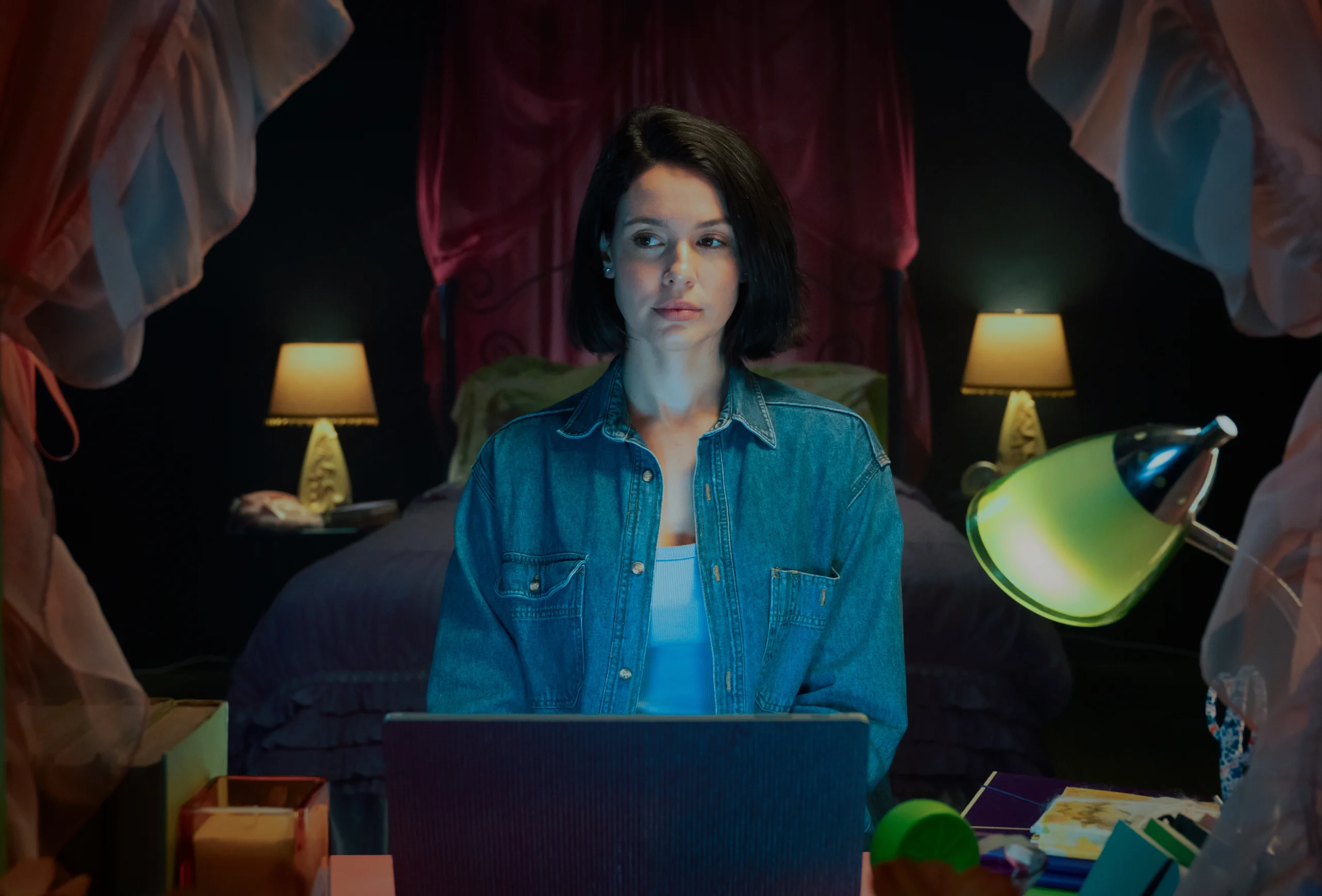
There are these dramatizations where you see a certain side of Andrea, but then you have these sit-down conversations with her partner, with her mother, with other sex workers, and there is a significant shift in tone. Why was it important to include those very grounded conversations as well?
I love how you mentioned that it is a shift in tone and that those moments feel grounded. It hopefully gives a bit of a reprieve from the intensity of the stylized reenactments and has this grounded element of, “OK, now we’re back to a more ‘real’ exchange”. We’re in this small and yet significant exchange — a very human conversation that feels intimate. I’m hoping that creates contrast with the bigger, broad-strokes, stylized moments, and gives us a moment to lock in on these relationships and what these folks have to say.
Seeing Andrea with her mom — who may not agree with her choice of work but still loves her unconditionally — is very loving and very simple in its way. That kind of representation is quietly revolutionary, and those moments can be a bit more subtle in the film. There’s meaning in capturing them on screen, and they don’t need to be more bombastic than that. So the film oscillates between more extreme, over-the-top moments and something quieter. I hope that creates an interesting ride along the way.
Modern Portrayals of Sex Work on Screen
From Nicole’s vantage point, having collaborated so closely with Andrea, I wanted her read on whether portrayal has changed in recent years, and how.
Over the last several years, there have been some notable films exploring sex work and sex workers. Anora is the big one, and Sean Baker served as Executive Producer on Modern Whore. We also had projects like Paying for It, another Toronto film that Andrea had a role in. Have you seen a shift in how sex work is being portrayed in recent years?
It’s exciting to see different projects come out that have to do with sex work. I’m hopeful it could help manifest change for sex workers — the kind of change that’s a long time coming in terms of sex worker rights and decriminalization. What is really key about Modern Whore is that this is a film made with a sex worker in a position of power. She is telling her own story on her own terms. I’m really excited to collaborate with her as the artist, and I’m grateful to be chosen to be part of that endeavour because I find it very meaningful.
I think I smell a sequel – Nicole Bazuin on what might be next for her collaborations with Andrea Werhun
Seeing these films be successful shows an appetite to experience sex worker stories. I’m hopeful that it can result in the kind of change these folks so rightly deserve, and that we see an evolution where films are made with their involvement in meaningful ways because they deserve to tell their own stories. Andrea is very forthright that her experience does not represent all sex work experiences, of course. We’re hopeful that if, in any way, this film is relatable to sex workers, that’s great — if they feel seen in some capacity by what’s on screen. But whether they do or not, if they would like to tell their own stories, we’re hoping this makes that more possible. There’s a cultural aspect — shame and stigma — which we talk about in the film, and that has a direct relationship with policies that make sex workers vulnerable. The hope is that this can shift culturally and have an impact on policy as well.
Yet still, there are many pervasive myths and misunderstandings. From your perspective, what are some major misconceptions people still have about sex work?
We start the film by stating that most of the representations you see in pop culture portray sex workers as “victims or villains”. It’s about acknowledging the power of representation: if those tired tropes keep getting regurgitated, that affects how sex workers exist in the world, impacting their health and safety in very negative ways. So the film starts by acknowledging those tropes and then seeks to investigate their existence, as well as offer a new archetype — a different path forward — that’s a lot more interesting, frankly, and a lot more realistic to how sex workers really are.
We specifically did not want this film to be dour. We didn’t want it to be a downer. Even if it goes to places that are difficult — and we felt we needed to go there — ultimately it’s meant to feel inspiring and invigorating on the other side. Just by not being dour in the way people might expect going into this subject matter, that alone is a shift. Humour is a big part of that too. Something Andrea often says — and that Sean Baker has said — is that if it doesn’t have humour, it’s not human. It’s very important that even if this story has humour and a lot of fun and intentional artifice, at the end of it, it’s a human story.
What’s Next for Nicole Bazuin and Andrea Werhun?
Nicole’s current work feels fresh and distinct — and almost all of it is deeply collaborative with Andrea. Because that voice is so particular, I needed to ask about what’s next and whether we’ll see more from this partnership.
Are you working on anything at the moment? More collaborations with Andrea? More “Virgin Twins” productions? What’s coming up for you?
It’s been really fun to release this film and feel like there’s a hunger for more, which is invigorating as an artist — to feel that people would like more. So, yeah… I think I smell a sequel. I don’t know if one feature film is enough to hold us with everything we’d like to explore. Stay tuned.


