


East of Wall Film Review: A Unique Docu-Fiction Portrayal of the “New West”
E
East of Wall, Kate Beecroft’s docu-fiction portrait of the “New West” resists tidy categorisation from its first minutes: we have country twang quickly matched with hip-hop beats (some perfectly apt Shaboozey collaborations). The film – like the Zimiga family at its centre – doesn’t sit in a single box, and that’s the point.
What is East of Wall About?
Set in and around South Dakota’s Badlands, East of Wall centres on Tabatha Zimiga, a rancher with piercings, tattoos, a warrior-like buzz cut, and a preternatural feel for horses others can’t tame. She plays herself; so does her teen daughter, Porshia Zimiga. Jennifer Ehle appears as Tabatha’s mother, Tracey, adding another generational perspective to the household’s story. Interestingly, one of the film’s most powerful sequences actually includes a brief cameo by Tabatha’s real-life mother, Tracey Osmotherly, alongside Ehle, with Ehle dressed in Tracey’s clothing, adding another meta-realistic layer.
Around these three generations of women orbit an older son (played by family friend Wyatt Mansfield) and a three-year-old son (Stetson Neumann) as himself. The household is still adjusting to the death of Tabatha’s husband (Porshia’s stepfather) the previous year. Tabatha hasn’t ridden since; instead, she coaches teens who perform trick riding and helps train horses for auction, and also for social media. As money runs increasingly thin, we are introduced to a wealthy businessman played by Scoot McNairy who offers to buy the family’s 3,000 acres.
The Complex and Contradictory Visual Language of East of Wall
From the first minutes, the film declares that it will move to its own rhythm. We are brought into a seemingly country soundtrack, only to have the music shift to rock and hip-hop beats, reinforcing the idea that the film, and the family it follows, cannot be easily categorised. This is also evident in the visual language of East of Wall. Beecroft employs a flexible, almost collage-like approach, as scenes shift from low-key interiors with visible grain to gorgeous wides that map the terrain, only to then incorporate vertical TikTok videos. That said, this sort of variability is a risk.The lack of a unified aesthetic can easily make the film feel disjointed. However, the inconsistencies work here: the Zimigas are improvising their survival in a media-saturated rural economy, where otherwise contradictory social media reels and horse auctions go hand-in-hand. On the whole, the filmic structure essentially mirrors the life of this family – noisy at times, but with pockets of beauty and calm.
Much of this elasticity comes from cinematographer Austin Shelton, who moves the camera from grainy interiors to the expansive Badlands with equal attentiveness. It’s also worth noting that the project itself began by accident: Beecroft and Shelton took a wrong turn while scouting and stumbled upon the Zimigas’ ranch, which led to Beecroft living with the family for three years (yes, really).
Beecroft’s Portrayal of Intergenerational Pain
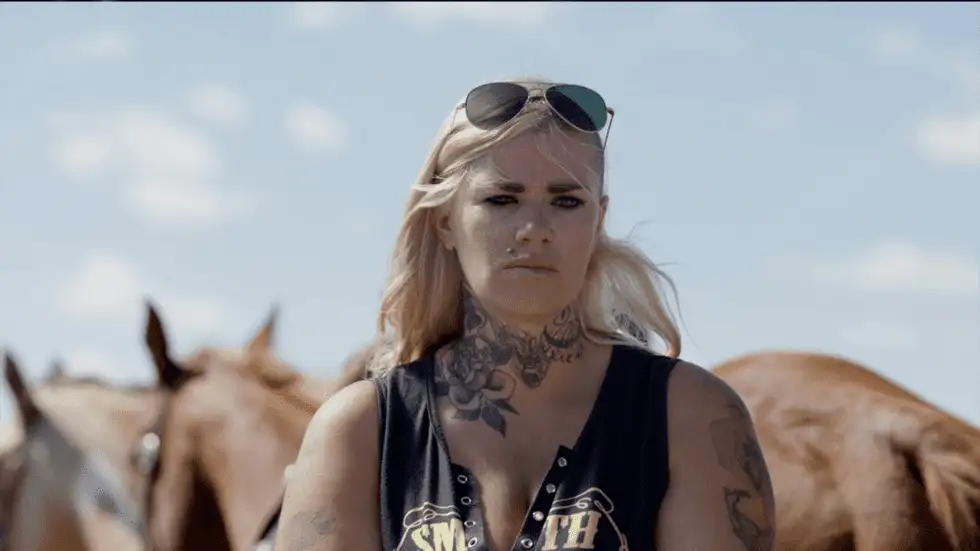
East of Wall is strongest when it emphasises the “New West” as a web of intergenerational relations and not simply landscapes and horses. Tabatha’s home is porous – kids and teens ebb and flow – and the film never passes judgement on the actions or inactions of these characters. There is an acknowledgement of a complex layer of events, both past and present, that have led each and every individual to this particular place at this particular moment. Beecroft and her collaborators also draw quiet parallels between the Zimigas and nearby Indigenous families without turning those neighbours into tired tropes. The emphasis is on shared pressures, an appreciation for what the land gives, and a sense of practical kinship, which is an appreciated pushback against the genre’s habit of “othering” Indigenous folks and lumping individual experiences into broad stereotypes.
These connections are further emphasised through Beecroft’s exploration of intergenerational struggles and cycles of trauma within the Zimiga family unit. Three generations of women, despite their surface-level frustrations with one another, are living through different chapters of the same story. This is, of course, reinforced through the matching buzz cuts of Tabatha and her daughter. While Porshia may not realise it, she is walking the same path as her mother and grandmother before her.
Is East of Wall Worth a Watch?
East of Wall is a unique exploration of the “New West” and the contradictory aspects of “self” that the real-life Zimiga family are grappling with. Beecroft is attentive to the textures of work, grief, and care on a specific patch of land just east of Wall, which lifts the film up when it starts to approach certain rural film tropes. It may be imperfect and uneven at times, but it still manages to capture intergenerational struggles and hybrid identity in a way that is wholly its own.
This is Beecroft’s feature debut, following earlier shorts like ¼ Cup and As Long As You Are Mine, and it shows a filmmaker willing to take formal risks in service of lived experience.


