


Ben Petrie on THE HEIRLOOM: Love, Dogs, and Abandoning the “Magnum Opus”
Sitting down with Ben Petrie is always a pleasure, and he and his partner, Grace Glowicki, have quickly become fixtures of Canada’s indie film scene. Both are quick to laugh and, above all, are genuinely invested in each other’s process. The last time I spoke with either of them was in Austin, Texas, where Grace’s film, Dead Lover, was playing at the 2025 SXSW Film & TV Festival. Something that has stayed in my memory is how the two of them looked at each other while the other spoke. Despite the potential stress that Ben’s latest film, The Heirloom, may have put on their relationship, each remained so clearly in awe of the other.
Fast forward a few months. As I spoke with Ben over Zoom about The Heirloom, he reflected on the give-and-take that fuels their collaborations and recalled their very first meeting on a snow-bound short film in Haliburton, Ontario (brought together by The Heirloom cinematographer, Kelly Jeffrey). While they were both in relationships at the time, and “no subtextual boundaries were crossed,” they spoke about collaborating in the future. As fate would have it, they both became single, and after a “tortured courting process,” they decided not just to collaborate on art, but also on life.
“The Heirloom was the most intimate of our collaborations because it was so personal and directly drawn from our lives”
That spirit of collaboration is the seed from which The Heirloom grew, but not in the way Petrie first imagined. After the success of his Sundance short “Her Friend Adam” (starring Grace, of course), he spent years labouring over what he once hoped would be a magnum opus: “The more time that went by, though, the greater I felt the final project had to be in order to justify how fucking long I’d spent on it.”
Eventually, the weight of those expectations proved paralysing – until COVID shrank life, and filmmaking, to the four walls of their Toronto apartment. What emerged instead was a modest, improvised chamber piece shot with a skeleton crew and most of the couple’s own furniture, shot just down the street from their actual home. Petrie now calls that pivot “an act of creative survival against the choke-hold of perfectionism.”
Ultimately, in place of meticulously scripted grandeur, The Heirloom became, quite literally, an heirloom: a hand-made record of two artists – and soon-to-be parents – navigating love, anxiety, and artistic ambition in lockdown.
What Is The Heirloom About?
Set in Toronto during the earliest months of the COVID-19 pandemic, The Heirloom follows Eric (Ben Petrie) and his partner Allie (Grace Glowicki) as they adopt Milly, a traumatized rescue dog from the Dominican Republic. Eric, a filmmaker obsessed with control, attempts to impose strict dog-training methods based on asserting leadership and inner strength. However, his disciplined approach soon begins to unravel, both in his handling of Milly and in his relationship with Allie, whose own introspective journey prompts a deeper examination of their lives together. Shot entirely in a reconstructed version of the actors’ real apartment, the film blends scripted narrative with improvised scenes drawn directly from Petrie and Glowicki’s personal experiences, ultimately exploring how easily the boundaries between art and reality can dissolve.
Ben Petrie and Collaboration with Grace Glowicki
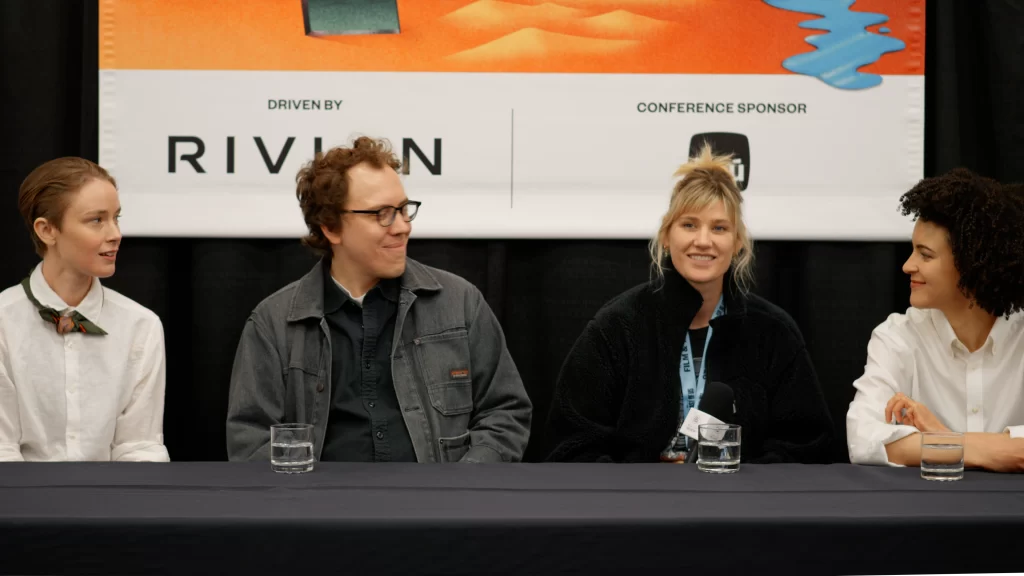
The success of The Heirloom is very much rooted in Petrie and Glowicki’s ability to collaborate, although the thin line between reality and fiction in this latest project offered additional challenges for the pair. When asked about their collaborative process, Petrie described it as finding a “shared centre in terms of our taste and what we value in film.” That push-and-pull keeps ideas elastic: it might be a left-field idea like smelly gravediggers, or it might be a lockdown story centred around an adopted dog, but both somehow orbit the same magnetic core of taste. Or, as Ben expands, “That shared centre becomes the centrifuge around which we spin … trying to find the combination that lights us both up equally.”
The apartment we see on screen isn’t the couple’s actual flat, yet it sits just down the street, outfitted with much of their own furniture. Shooting there kept crew footprints small and, more importantly, preserved a day-to-day familiarity that made full-scale improvisation feel safe. Scenes began only as skeleton ideas rooted in their past and grew in real time until the improvisation felt real: “The Heirloom was the most intimate of our collaborations because it was so personal and directly drawn from our lives. It’s been different for every project we’ve worked on – really, it varies per film.”
This hyper-personal collaboration inherently lent itself to a meta-textual project: the characters actively debate the ethics of borrowing real anxieties for art, even as the film itself does exactly that. It’s fiction, yes, but one grounded in lived reality – an experiment that invites the audience inside the most intimate and difficult moments in their relationship.
Navigating Between Fiction and Reality in The Heirloom
Petrie admits that blurring life into art “really seems insane in retrospect,” yet lockdown left him little choice: “My life had become so winnowed and small; all that I knew was what happened in the confines of our apartment, and just the canvas of my imagination existed totally within that dry-walled space.”
The film’s first half, he explains, was almost documentary: “In the first half of the movie, we were reenacting things that we had gone through … it was quite surreal and uncanny.” Those real arguments could be tilted “for a little bit of comedy or a little bit more pathos,” but the beats were essentially pre-written by life itself.
“The words she was saying rang true because they were coming from the reality that I had actually subjugated our life to be mined for this film and extracted from for this film for weeks at a time”
Halfway through, reality caught up to production. “By the second half, the filmmaking process had caught up to where we were at in the lives that we were drawing from … we were no longer reenacting things that had already happened.” The camera became a mirror held to their current lives: “We weren’t reenacting – we were interpreting the present … [and that] became much scarier and much more difficult.”
That collapse of boundaries peaked in a deceptively still scene: two characters seated across a room while Allie recounts a dream. Without spoiling details, her story lands with almost immeasurable impact, and it becomes clear that she has no faith that Eric will ever be a good father. The subtext, understandably, sliced close to the bone. Ben reflected candidly on this scene, recounting how Grace’s performance triggered his anxieties about parenthood and self-worth so deeply that he dismissed her exceptional performance as “unusably bad.” This conflation of director and personal self, Ben admitted, became profoundly disorienting, illustrating just how deeply personal and challenging the creative process had become.
This sort of openness is something that should be acknowledged, particularly when we live in a world where more and more of what we see is manufactured and polished to the point that any initial “truth” becomes unrecognisable.
The “Alpha Voice” as Metaphor for Cruel Self-Talk
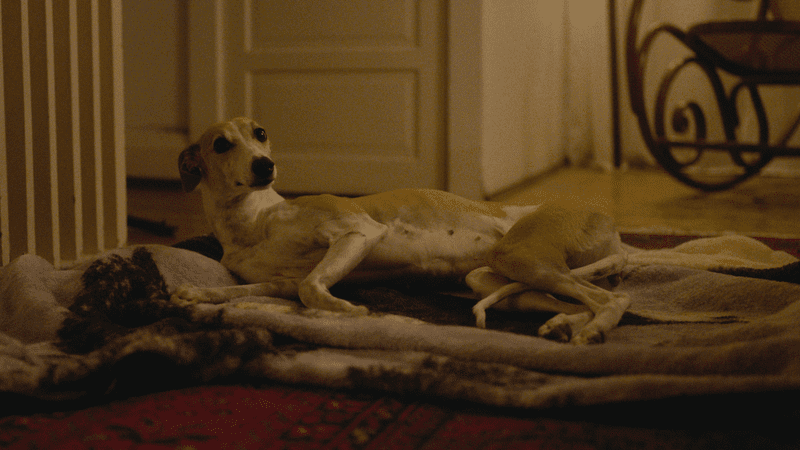
My connection to The Heirloom runs deeper than simple appreciation. After Ben read my initial review of the film, I reached out to him on Instagram, mentioning that his character hit “a little bit too close to home.” Specifically, Eric’s internal voice – an increasingly harsh and negative self-dialogue – resonated profoundly with me. Ben discussed this during our conversation, explaining how the film’s dog-training philosophy became a metaphor for his own internal struggles: “The dog is going to be so sensitive to his pheromonal fluctuations and his micro-behaviours that she’s practically able to read your emotions – you can’t lie; your pheromones won’t lie.”
“I made a concerted effort to clench and control my thoughts and feelings so that what she perceived in me would be reassuring to her as this kind of anxious creature”
Ben further reflected on how this philosophy intersected with his personal anxieties, noting that their dog’s “presence for me was like an X-ray in the corner of the room, an all-seeing eye of Soran that could see through me and feel what I was feeling.” This intense scrutiny led to a spiral of negative self-awareness: “I started bringing that perfectionism that I brought to my work onto my dog … I started to notice all of this negative self-talk and just all of these projections, all of these little manipulations and gestures of passive aggression.”
This insight mirrors my own experiences. In fact, my internal perfectionism delayed this very article. My critical inner voice consistently held me back, insisting the work wasn’t ready or good enough. In the film, this sort of perfectionism is illustrated through Eric’s obsessive practice of sticking notes to his office walls, to the point that they make up more of the wall than the empty space that was once there. These feelings of perfectionism and negative self-talk also affected the way he interacted with Grace at times, both in real life and in The Heirloom, applying “negative projections onto Grace and onto so many elements of [his] life.”
The Heirloom and the Irony of Perfectionism
Ben’s struggle with perfectionism is profoundly ironic when contrasted against the film’s improvisational method. Over 150 hours of improvised footage needed to be shaped into a coherent narrative, which is an enormous challenge. Ben openly credits his editors, Michael Harmon and Brendan Mills, as pivotal in navigating this overwhelming creative task. He emphasised, “They were essential … guiding me through it … they saved the film, and they saved me.”
This improvisational approach is notably atypical for narrative filmmaking, which traditionally emphasises detailed planning and explicit storyboarding. Instead, the process was more akin to documentary filmmaking, where the final story emerges in the editing room. This choice further emphasises the blurring of lines between reality and fiction.
One other particularly impactful moment in The Heirloom is when Grace’s character explicitly confronts this tension, declaring, “My life is not a movie.” Again, something that undoubtedly rang true to Ben as director, but also Ben as Grace’s partner.
Toronto’s Indie Filmmaking Community
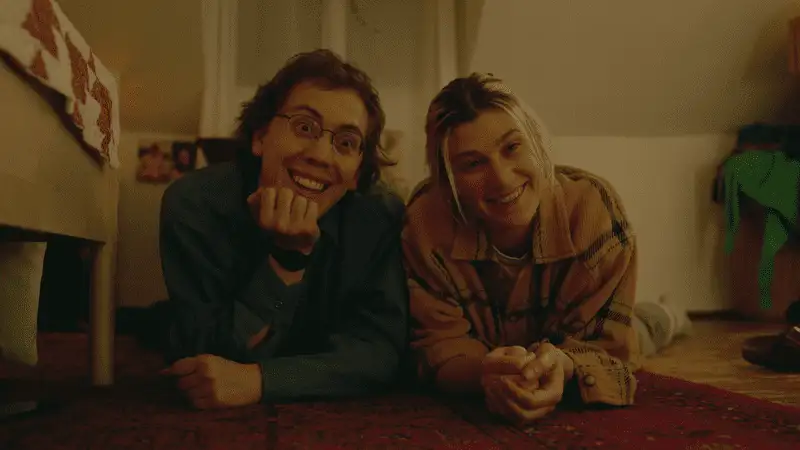
Ben and Grace’s commitment to authenticity, and to each other, exemplifies the broader ethos of Toronto’s indie filmmaking community, where familiar faces frequently reappear across multiple projects. Leah Doz, for instance, featured prominently in Dead Lover (Grace’s SXSW project) and had another small role in The Heirloom. Similarly, Ben’s ongoing creative relationship with filmmaker Matt Johnson highlights the interconnectedness and collaborative spirit of this community. Ben recalled reaching out to Matt one evening to ask him to participate in the film, with Matt casually responding, “Sounds good—like right now?” – demonstrating the spontaneous, supportive environment that defines Toronto indie filmmaking. g film Nirvanna the Band the Show the Movie.
Petrie’s Willingness to Embrace Imperfection
Ultimately, The Heirloom may not be the expansive “magnum opus” Ben Petrie initially envisioned. Still, by relinquishing grand expectations, Ben created a deeply resonant, authentically personal film. The Heirloom stands as a poignant reminder that meaningful creativity often emerges not from perfection but from embracing authenticity. I truly hope more people experience this film, not because it is flawlessly polished, but precisely because it embodies imperfection, honesty, and emotional truth.


